
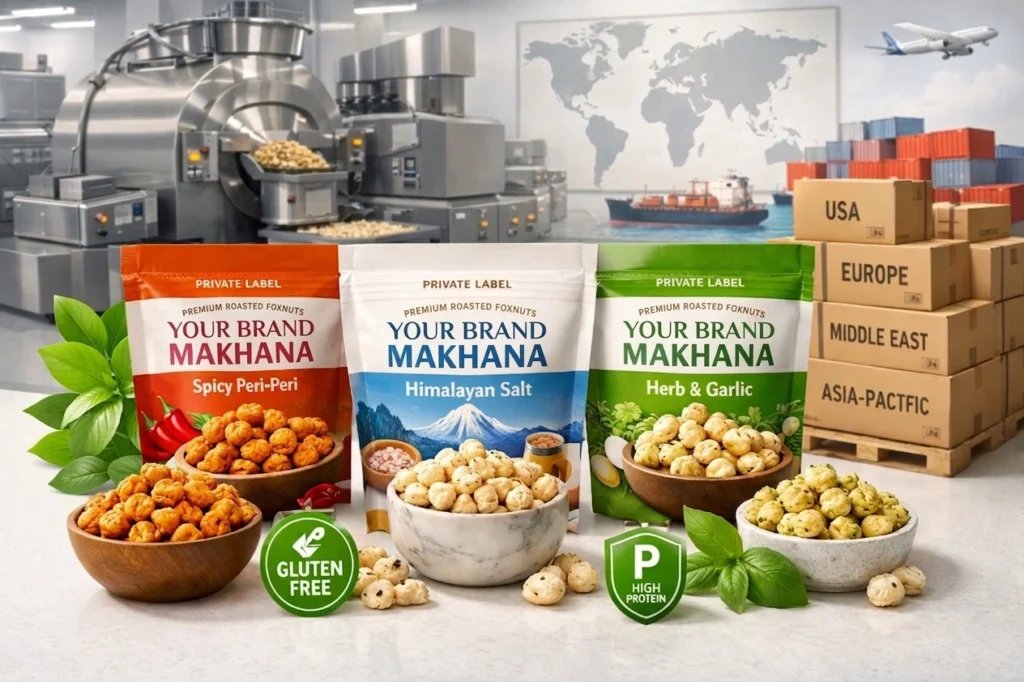
Global snack brands operate in a market where consumers expect the same product experience every time they make a purchase. As healthy snacking continues to gain attention, makhana has become an attractive ingredient for brands seeking differentiated products. However, transforming makhana into a dependable commercial snack requires more than sourcing the raw material. Brands need controlled processing, repeatable production, reliable packaging, and strong quality systems. A private label makhana manufacturer can provide these capabilities while allowing brands to concentrate on marketing, distribution, and international growth.
Why Consistency Matters in Global Snack Markets
International consumers can easily tell whether there are differences in taste, texture, freshness, or appearance. People’s choices when purchasing a product and their opinion of the brand can be influenced by even small variations.
A professional private label makhana manufacturer helps establish consistent standards across production batches through:
- Standardised processing procedures
- Controlled ingredient handling
- Defined quality parameters
- Consistent seasoning application
The more customers have the same experience repeatedly, the more trust companies can build and the more they will be able to encourage additional purchases.
Reliable Processing Creates Product Stability
In order to keep the required texture and quality of the product, makhana must be handled with care at every stage of processing and the manufacturing processes have to be organised so as to reduce unnecessary variation.
A skilled producer of private label makhana can carry out the major stages of production—such as roasting, seasoning, cooling, and packaging—by using well-established methods.
This methodological approach results in more consistent outcomes across different production runs and makes it possible to carry out commercial distribution with reliability.
Quality Control Protects Brand Reputation
The business that sells a private label product—since the product is named after the retailer or the brand—suffers directly from any quality problems and therefore requires a good quality control system.
A capable private label makhana manufacturer can implement quality checks covering:
- Raw material quality
- Product appearance
- Flavor consistency
- Packaging integrity
- Finished product standards
It is useful to carry out systematic inspections in order to detect any variations in production before the products reach the customers.
Consistent Seasoning Strengthens Product Identity
Since flavour is an important aspect of the branding of snacks, people who enjoy a particular flavour will expect to taste the same thing each time they buy it.
As brands need to offer a range of flavours, for example, spicy, savoury, tangy or premium ones, private label manufacturers can use controlled seasoning processes to guarantee consistency from batch to batch.
For global brands, maintaining a consistent flavour helps to establish a distinct product identity in different markets.
Packaging Consistency Supports Retail Presentation
The role of packaging extends beyond that of providing protection, since it represents the brand at the point of purchase and influences the way consumers assess the quality of the product.
A private label makhana manufacturer can support brands with standardised packaging specifications, helping maintain:
Consistent pack appearance
Accurate product information
Reliable sealing
Uniform retail presentation
It is especially important to have uniform packaging when products are distributed in many countries and by different retail channels.
Private Label Manufacturing Simplifies Global Expansion
Setting up their own manufacturing plant is difficult for snack brands that are expanding because such companies have to make investments in equipment, staff, production management, and quality systems.
By collaborating with a private label makhana manufacturer, brands can obtain access to the existing manufacturing facilities without having to assume full responsibility for operating a production facility.
This allows businesses to allocate greater attention to:
International marketing
Retail partnerships
Distribution development
Consumer acquisition
The result is an increased focus on global expansion.
Scalable Production Supports Growing Demand
A snack product can begin with a limited release before becoming available through a number of retailers or in several countries and the manufacturing capacity must then be increased as demand does.
A trustworthy private label makhana manufacturer can provide scalable production planning, allowing companies to increase their output as greater market acceptance is attained.
The capacity for scaling enables brands to progress from testing in the market to wider commercial distribution without being forced to alter their whole manufacturing model.
Customisation Keeps Global Brands Differentiated
There is no need for all products to have an identical appearance, and brands should therefore be allowed the freedom to produce unique products for specific audiences.
A private label makhana manufacturer can support customisation through:
Flavor variations
Different pack sizes
Customized branding
Market-specific packaging
Product assortment development
The existence of a balance between standardisation and customisation allows brands to maintain consistency in their operations while at the same time providing different products.
Supporting Multiple Retail Markets
Global snack brand companies have the opportunity to sell their products in supermarkets, in speciality stores, on online marketplaces, in health-focused retailers, and via distributors, since different product requirements arise from each of these channels.
Having a trustworthy manufacturing partner allows brands to maintain consistent production while at the same time making changes to their packaging and their order requirements for different channels.
It thus provides businesses that are setting up diversified distribution networks with a practical solution.
Building a Dependable Long-Term Partnership
A choice regarding which manufacturing partner to select cannot be based simply on the availability of the product, as long-term success depends on good communication, reliable production, consistent quality, the ability to offer customisation, and effective supply planning.
A strong producer of private label makhana is included in the brand’s operational system, taking charge of the production whilst the brand handles the promotion of its products, the development of its customer relationships, and the establishment of its product strategy.
As the business grows, the partnership model can offer greater stability.
Creating a Strong Foundation for Global Snack Growth
Makhana gives brands the opportunity to develop modern snack products with a clear market position of their own. However, successful international growth will only result from the consistent implementation of the product.
A producer who manufactures makhana under his own label can offer the know-how involved in production, along with quality control systems, the possibility of customisation, and the capacity to increase output so as to guarantee that the consumer experience stays the same. By outsourcing their manufacturing to a capable partner, owners of global snack brands are able to simplify their operations and can then concentrate on improving their products, expanding their distribution networks, and enhancing their relationships with customers.
How Can Annakosha Pvt. Ltd. Help?
Annakosha Pvt. Ltd. is a reliable private label manufacturer of makhana, offering consistent processing, custom flavours, scalable production, quality control and retail-ready packaging. The company helps global snack brands to develop their own distinctive makhana products while at the same time maintaining reliable standards, flexible manufacturing, and a continuous supply in both the domestic and international markets.
FAQs
1. What is the role of a private label makhana manufacturer?
A private label makhana manufacturer produces makhana products for other companies, which in turn sell these products using their own brand names. The manufacturer takes charge of all the steps involved, such as sourcing the raw materials, processing them, packaging the products, and at times also carrying out the labelling. This arrangement enables businesses to sell makhana snacks without having to operate their own factories.
A company that makes makhana products for private labels supplies makhana-based snacks to businesses that sell them under their own brand name.
2. What is it that makes consistency important for global snack brands?
Since it is consistent, customers always get the same taste, texture, appearance, and quality when they buy the product, which in turn helps to protect the brand’s reputation and encourages ongoing purchases.
3. Can a private label makhana manufacturer make custom products?
Brands can generally adapt their flavours, packaging, branding, pack sizes, and product ranges to meet the requirements of their target market.
4. How does the manufacture of private label products contribute to international expansion?
This enables brands to get access to existing production facilities and to take advantage of scalable manufacturing without having to build and manage their own manufacturing plant.
5. What ought brands to consider when selecting a private label makhana manufacturer?
In evaluating a brand, one ought to consider its production capabilities, its quality control systems, the extent of customisation it provides, its scalability, its expertise in packaging, the reliability of its supply chain, and its experience in dealing with international markets.
