
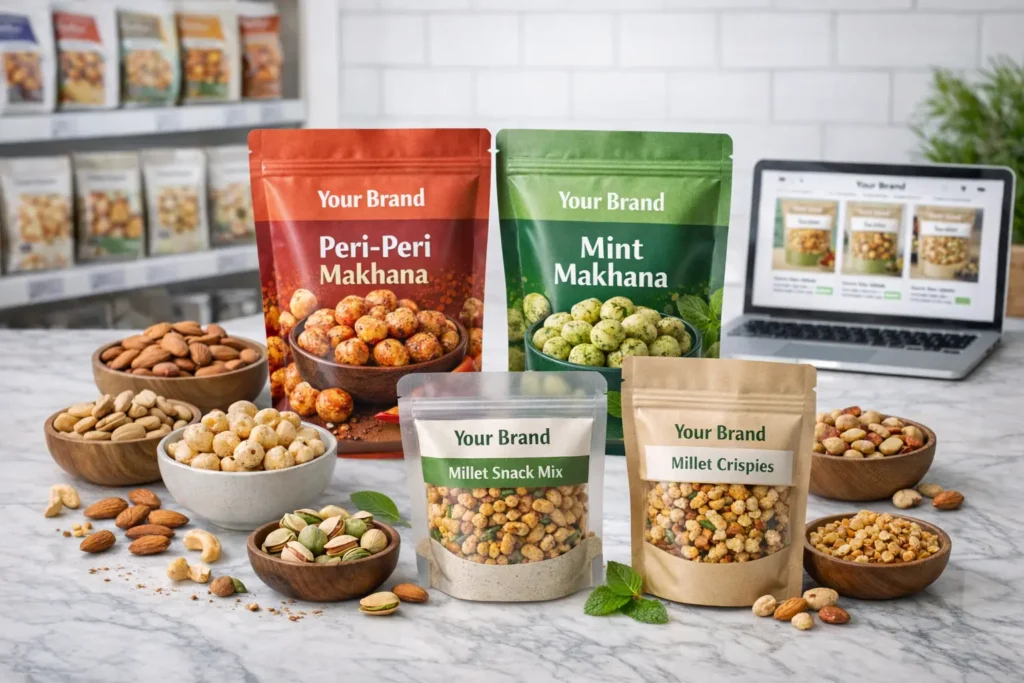
Launching a food brand is easy to imagine but much harder to validate. A snack may look attractive, taste good, and have professional packaging, yet still struggle to generate repeat purchases.
For a snack business USA, product-market fit means finding a clear connection between what the brand offers and what a defined group of American consumers actually wants to buy repeatedly.
This does not necessarily mean creating a snack that appeals to everyone. In a crowded category, a focused product designed for a specific consumer need can have a stronger commercial opportunity than a generic product targeting the entire market.
Start With the Customer Problem
Product-market fit should begin with a customer problem rather than a manufacturing capability.
Consumers may want convenient snacks for work, better options for travel, portion-controlled products, flavorful alternatives to traditional snacks, or products that fit particular dietary preferences.
A snack business USA should identify one or more of these needs before finalizing its product concept.
Useful questions include:
- Who is most likely to purchase the product?
- When will they consume it?
- What problem does the snack solve?
- What alternatives are they currently buying?
- Why would they switch?
- What price feels reasonable to them?
Clear answers can provide a stronger foundation for product development.
Choose a Narrow Initial Target
Trying to satisfy every American shopper from the beginning can make product positioning unclear.
A startup might instead focus on office professionals, fitness-oriented consumers, families, specialty retailers, online shoppers, or customers seeking premium Indian-inspired snacks.
For a snack business USA, narrowing the initial audience can make decisions about flavor, packaging, messaging, pricing, and distribution considerably easier.
Once the brand establishes traction within one segment, it can explore adjacent audiences without changing its entire identity.
Test the Product Before Scaling
A common mistake is investing heavily in inventory before confirming demand.
Small-scale product testing can provide useful commercial information. A brand can introduce a limited selection of flavors or formats, collect customer feedback, monitor sales, and identify which products generate stronger interest.
This approach allows a snack business USA to learn before making larger manufacturing commitments.
Testing can evaluate:
- Flavor preference
- Pack-size preference
- Price sensitivity
- Purchase frequency
- Customer reviews
- Repeat orders
- Product positioning
Real customer behavior often provides more useful information than assumptions made during product planning.
Treat Pricing as Part of Product-Market Fit
A product can have excellent reviews and still fail commercially if its price does not match the perceived value.
Pricing should therefore be evaluated alongside taste, packaging, positioning, and target audience.
A premium snack may justify a higher price through ingredients, presentation, product differentiation, or brand experience. An everyday snack may need a more accessible price to encourage frequent purchases.
For a snack business USA, the right question is not simply “What does it cost to manufacture?” but also “What value does the target customer believe they are receiving?”
Use Packaging to Communicate the Product Quickly
Consumers often make purchasing decisions within seconds while browsing shelves or online listings.
Packaging needs to communicate what the product is, why it is different, and who it is intended for.
A snack business USA can use packaging to highlight its strongest product attributes while maintaining a clear and recognizable visual identity.
Online, the same principle applies to product images, titles, descriptions, and marketplace content. If customers cannot understand the product quickly, even a strong snack can struggle to gain attention.
Build a Product Around Repeat Purchases
The first purchase proves that a customer is curious. The second purchase provides stronger evidence of product-market fit.
Brands should therefore study repeat behavior rather than focusing exclusively on initial sales.
Questions worth tracking include whether customers reorder the same flavor, purchase larger packs, try additional products, recommend the snack, or subscribe for recurring deliveries.
A successful snack business USA should aim to create products that become part of a customer’s regular routine rather than relying entirely on one-time promotional purchases.
Learn From Negative Feedback
Not every customer complaint indicates a bad product. Sometimes feedback identifies an opportunity for refinement.
Customers may find a flavor too strong, a package difficult to open, a serving size too small, or the product too expensive for frequent consumption.
Instead of treating negative feedback as failure, a snack business USA can use it as product-development data.
Patterns are especially valuable. If several customers independently mention the same issue, the brand has a practical signal that something may need adjustment.
Scale Only After the Formula Works
Once a product demonstrates consistent demand, the next challenge is scaling without damaging the customer experience.
The brand needs dependable manufacturing, consistent quality, reliable packaging, inventory planning, and sufficient production capacity.
This is where a capable manufacturing partner can become strategically important.
A snack business USA can focus on marketing, distribution, retail relationships, and customer acquisition while an experienced manufacturing partner manages the production side.
Scaling should therefore follow validation, not replace it.
Turning Product-Market Fit Into Long-Term Growth
Product-market fit is not a single milestone that permanently completes a snack brand. Consumer preferences, competitors, pricing, and retail environments continue to change.
Successful brands continue monitoring their customers and refining their portfolios.
The strongest approach is to establish one validated product, understand why customers buy it, and then use those insights to develop logical extensions.
For a snack business USA, this creates a repeatable growth model: identify a need, develop a focused product, test demand, learn from customers, refine the offer, and scale what works.
How Can Annakosha Pvt. Ltd. Help?
Annakosha Pvt. Ltd. helps a snack business USA turn validated concepts into commercially scalable products through private label manufacturing. From product development and flavor trials to packaging coordination, quality control, and production planning, Annakosha supports brands as they refine market-ready snacks while concentrating on customer acquisition, retail expansion, distribution, and long-term growth.
FAQs
1. What is product-market fit for a snack business USA?
Product-market fit occurs when a snack successfully meets a specific consumer need and generates sufficient demand, satisfaction, and repeat purchasing.
2. How can a snack business USA test product-market fit?
A brand can test limited product quantities, flavors, pack sizes, and pricing while tracking sales, customer feedback, reviews, and repeat purchases.
3. Should a snack startup target everyone?
No. Starting with a clearly defined customer segment can make product positioning, marketing, pricing, and distribution more focused.
4. Why are repeat purchases important?
Repeat purchases indicate that customers find enough value in the product to buy it again, providing stronger evidence of sustainable demand.
5. How does pricing affect product-market fit?
Pricing influences perceived value and purchase frequency. A successful snack needs a price that customers consider appropriate for its quality and positioning.
6. Can private label manufacturing help a snack business USA?
Yes. Private label manufacturing can allow brands to develop and scale products without establishing their own manufacturing infrastructure.
7. When should a snack business USA scale production?
A brand should consider larger-scale production after testing demonstrates consistent demand, acceptable customer feedback, viable pricing, and potential for repeat purchases.
