
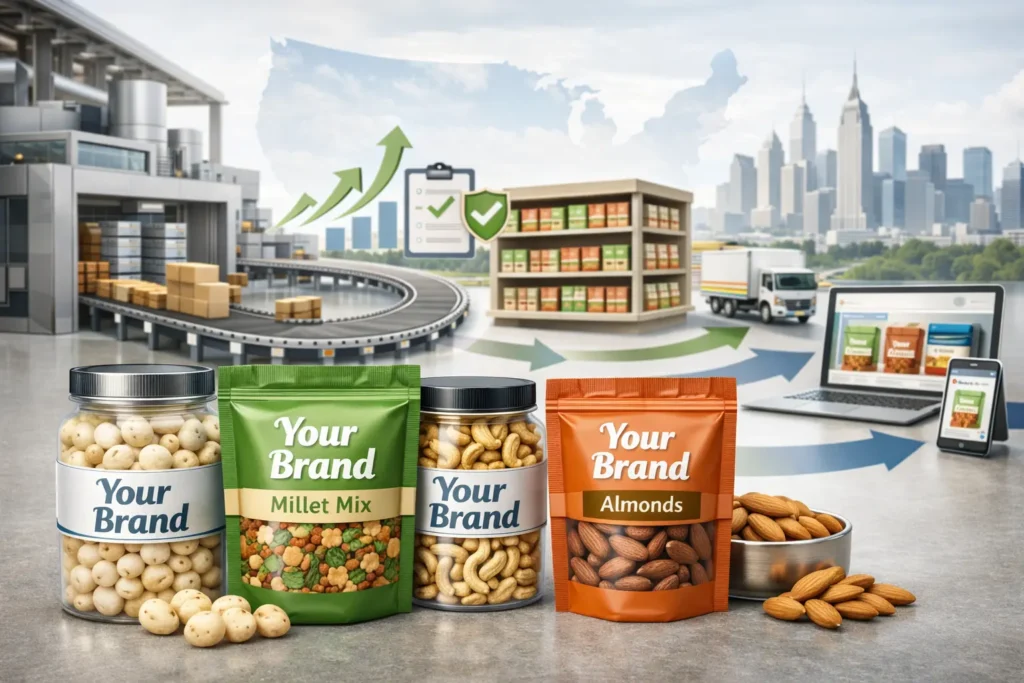
Many entrepreneurs begin a snack brand by thinking about logos, packaging, social media, and advertising. These elements matter, but a successful food business needs a stronger foundation underneath the brand.
If you want to start a snack brand USA, product and supply decisions should be considered before investing heavily in marketing. A great brand cannot compensate for inconsistent quality, unreliable production, unsuitable packaging, or supply interruptions.
The smarter approach is to build the commercial foundation first and then scale the brand around it.
Define the Product Before Building the Brand
Before choosing a brand name or designing packaging, establish exactly what you are selling.
Start by defining the product’s:
- Core ingredients
- Flavor profile
- Texture
- Target consumer
- Pack size
- Expected selling price
- Consumption occasion
- Product positioning
When you start a snack brand USA, these decisions influence almost everything that follows, including manufacturing requirements, packaging costs, logistics, and marketing communication.
A clearly defined product also makes it easier to communicate your expectations to a manufacturing partner.
Select Products With Commercial Potential
Not every interesting snack concept is commercially practical.
A product may taste excellent but have expensive ingredients. Another may have attractive packaging but limited repeat-purchase potential. Some products may be difficult to transport or require complicated production processes.
Entrepreneurs looking to start a snack brand USA should evaluate the complete commercial equation.
Consider whether the product has:
- A clear target audience
- Competitive pricing potential
- Attractive margins
- Repeat-purchase possibilities
- Suitable shelf life
- Practical transportation requirements
- Opportunities for future product extensions
This evaluation can prevent a brand from investing in an idea that becomes difficult to scale.
Build the Manufacturing Strategy Early
Manufacturing should not be treated as an activity that begins after branding is completed.
Production capacity, minimum order quantities, raw-material availability, quality requirements, and lead times can directly influence the business model.
For entrepreneurs who want to start a snack brand USA, working with an experienced private label manufacturer can provide a more practical route than establishing a dedicated production facility.
Outsourcing manufacturing allows the brand owner to concentrate on sales, distribution, customer relationships, and market development while the manufacturing partner manages production.
Create a Reliable Raw-Material Supply System
A snack business depends on consistent access to suitable ingredients.
Changes in raw-material quality can affect taste, appearance, texture, and production consistency. Supply interruptions can also create delays in fulfilling retailer or distributor requirements.
Therefore, a start a snack brand USA strategy should include raw-material planning from the beginning.
Businesses should understand:
- Where ingredients are sourced
- How quality is evaluated
- Expected procurement lead times
- Seasonal availability
- Backup sourcing possibilities
- How raw-material changes could affect the final product
A dependable supply structure can become a competitive advantage as the brand grows.
Treat Packaging as a Supply Decision
Packaging is often viewed only as a branding element. In reality, it is also part of the supply chain.
The selected packaging format affects procurement, storage, transportation, filling, production scheduling, and overall product cost.
A startup planning to start a snack brand USA should therefore evaluate packaging alongside manufacturing rather than selecting it independently.
Pack sizes should also reflect the intended sales channel. Retail shelves, e-commerce marketplaces, convenience stores, and direct-to-consumer sales may require different packaging strategies.
Calculate the Economics Before Scaling
A product’s selling price should not be selected simply by looking at competitors.
The brand needs to understand its complete cost structure, including manufacturing, ingredients, packaging, freight, warehousing, marketplace fees where applicable, promotions, and distribution expenses.
For anyone trying to start a snack brand USA, unit economics should answer an important question:
Can the product remain profitable when the business grows?
A healthy margin at small volumes may change when distribution expands or promotional spending increases. Building realistic cost assumptions early makes future decisions easier.
Plan Inventory Around Demand
Too little inventory can lead to stockouts. Too much inventory can tie up capital and increase storage pressure.
A growing snack brand needs a practical balance between production schedules and expected demand.
Instead of manufacturing large quantities based only on optimism, businesses can use initial sales data to improve forecasting.
When you start a snack brand USA, a phased inventory strategy can provide flexibility. Initial production can validate demand, while stronger-performing products receive greater inventory support as sales become more predictable.
Build Supply Flexibility Into the Business
Growth rarely happens in a perfectly predictable pattern.
A product may suddenly gain attention through an online campaign, retailer listing, distributor partnership, or social-media exposure. If the supply system cannot respond, the brand may lose momentum.
This is why entrepreneurs should discuss scalability with their manufacturing partner before the product becomes successful.
A strong start a snack brand USA strategy considers both today’s production requirement and tomorrow’s potential volume.
Keep the First Product Portfolio Focused
Launching too many products can create unnecessary complexity.
Every additional SKU may require different ingredients, packaging materials, production planning, inventory, and marketing investment.
A better approach is to establish a focused initial range and expand after understanding customer response.
Once one or two products demonstrate strong potential, the brand can introduce complementary flavors, formats, or pack sizes.
This creates controlled expansion rather than uncontrolled product proliferation.
Connect Product Strategy With Distribution
The right product must reach the right customer through the right channel.
A snack intended for online consumers may require different pack configurations from a product designed for supermarkets. Distributor-led expansion can also create different requirements for case quantities, logistics, and inventory planning.
Therefore, when you start a snack brand USA, distribution should influence product and supply decisions from the beginning.
This integrated approach helps prevent situations where the product is ready but the supply system is not prepared for the chosen sales channel.
How Annakosha Pvt. Ltd. Can Help?
Annakosha Pvt. Ltd. helps businesses start a snack brand USA through private label manufacturing, supporting product development, flavor customization, packaging coordination, quality control, and scalable production. Its manufacturing support allows entrepreneurs to build reliable supply systems while focusing on branding, sales, distribution, customer acquisition, and market expansion across competitive snack categories.
FAQs
1. What should I do first to start a snack brand USA?
Begin by defining the product, target customer, positioning, pricing, manufacturing requirements, packaging, and supply strategy before making significant marketing investments.
2. Can I start a snack brand USA without owning a factory?
Yes. Private label manufacturing allows businesses to launch branded snacks without establishing and operating their own manufacturing facility.
3. Why is supply planning important for a snack startup?
Supply planning helps maintain consistent product quality, avoid stockouts, manage costs, and support reliable fulfillment as sales increase.
4. How many products should a new snack brand launch?
A focused range of one or a few strong products can be easier to manage and validate before expanding into additional SKUs.
5. What should I consider when choosing a snack manufacturer?
Consider product-development capabilities, quality systems, production capacity, customisation, packaging support, lead times, consistency, and scalability.
6. How important is packaging when launching a snack brand?
Packaging affects brand presentation, product protection, manufacturing, logistics, storage, and cost, making it both a marketing and supply-chain decision.
7. When should a snack brand expand production?
Production should generally increase when sales data demonstrates sustainable demand and the business has sufficient distribution, inventory planning, and manufacturing capacity to support growth.
