
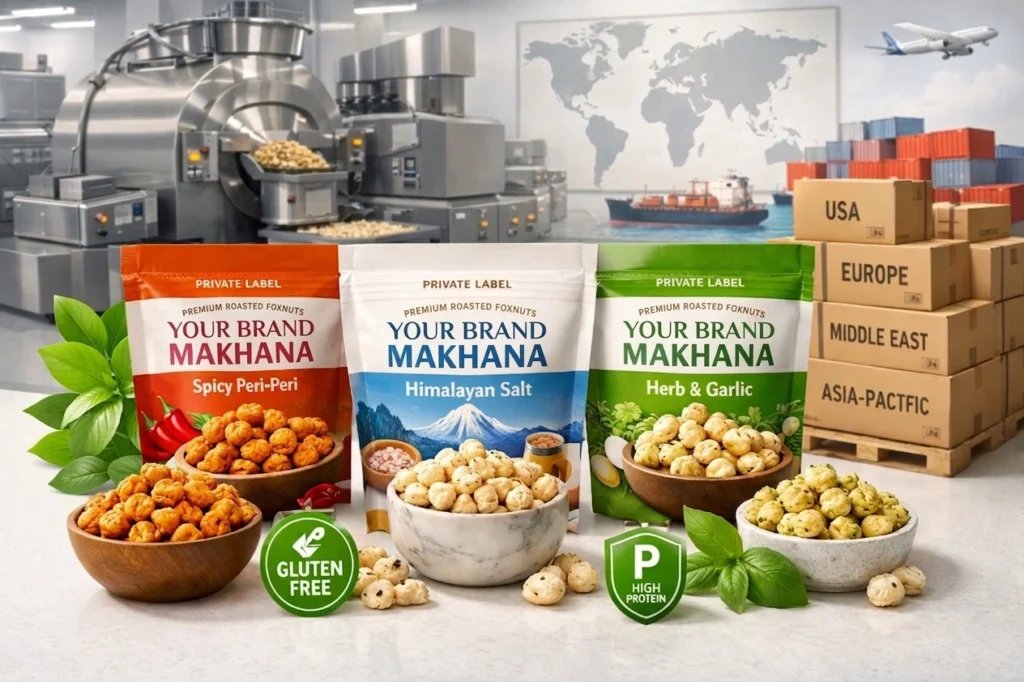
A snack business often begins with a simple idea: a particular flavour, texture, pack concept, or customer requirement. Turning that idea into a commercially viable product, however, requires much more than creating a recipe.
A private label makhana manufacturer can bridge this gap by helping businesses move from an initial concept toward a finished product that is suitable for selling.
This makes private label manufacturing particularly useful for entrepreneurs, retailers, distributors, and established food businesses that want to introduce makhana products without building their own production setup.
What Happens Between an Idea and a Finished Makhana Product?
The journey from concept to commercial product involves several decisions. A brand must determine what the product should taste like, how it should look, who will buy it, how much it should cost, and where it will be sold.
A private label makhana manufacturer can support this process by coordinating different manufacturing requirements under one production framework.
The development process may include:
- Product concept evaluation
- Makhana grade and size selection
- Flavour and seasoning development
- Trial production
- Texture and taste evaluation
- Packaging selection
- Production planning
- Quality checks
- Commercial manufacturing
This structured process can make product development more practical and reduce the difficulty of coordinating multiple suppliers.
Translating Consumer Ideas Into Product Specifications
Consumers rarely describe products using technical manufacturing language. They may simply want something crunchy, spicy, lightly seasoned, premium, or suitable for everyday snacking.
The challenge is converting these expectations into measurable product specifications.
A private label makhana manufacturer can help translate a brand’s positioning into decisions related to seasoning intensity, product consistency, pack configuration, and manufacturing requirements.
For example, a premium snack may require a different flavor profile and packaging approach than an economical everyday product.
The manufacturer therefore becomes part of the product-development process rather than only a production facility.
Building the Right Flavour Concept
Flavour is one of the most important elements when converting a makhana idea into a commercial product.
Brands can explore familiar profiles, regional inspirations, or distinctive combinations depending on their target market. However, a flavour that sounds attractive on paper still needs to perform consistently during actual production.
A private label makhana manufacturer can help brands move through sampling and refinement before finalizing a commercial recipe.
This stage allows businesses to assess taste, aroma, coating, crunch, and overall eating experience before committing to larger production quantities.
Choosing Makhana According to the Product Positioning
Not every makhana product needs the same raw-material specification.
The desired appearance, texture, product positioning, and selling price can influence the appropriate makhana grade and processing approach.
For a premium product, visual uniformity and presentation may receive greater attention. For another product, the commercial priority may be achieving an attractive price while maintaining an enjoyable snack experience.
Working with a private label makhana manufacturer allows brands to discuss these requirements before production rather than treating raw material selection as an isolated purchasing decision.
Turning Packaging Into Part of the Product
A commercial snack is not only what is inside the packet. Packaging influences shelf presentation, convenience, communication, and product positioning.
Brands may choose different pack sizes for supermarkets, online marketplaces, offices, travel, or trial purchases.
The packaging also needs to work with the product itself. Protection, sealing, storage requirements, labeling, and transportation should be considered during development.
A capable private label makhana manufacturer can coordinate manufacturing requirements with the brand’s selected packaging format, helping create a more complete market-ready product.
Testing Before Full-Scale Production
One of the biggest differences between an idea and a commercial product is repeatability.
A sample may taste excellent once, but a scalable snack needs to deliver a consistent experience across production batches.
Trial runs allow brands to assess whether the product specification works in a manufacturing environment. Businesses can review seasoning distribution, texture, packaging compatibility, appearance, and other requirements before moving toward regular production.
This step can help identify problems early and create a clearer specification for future batches.
Creating Products Around Commercial Objectives
Product development should ultimately connect with business objectives.
A brand may want to create an affordable entry-level SKU, a premium makhana product, a high-volume retail pack, or a differentiated product for online marketplaces.
Each objective can influence formulation, packaging, pack size, and production planning.
A private label makhana manufacturer gives businesses an opportunity to develop products with these commercial considerations from the beginning rather than attempting to adapt an already-finished product afterward.
Making Innovation Easier for Growing Brands
Innovation does not always mean inventing an entirely new snack category. Sometimes, it means identifying a better combination of flavor, format, packaging, positioning, and customer need.
Private label manufacturing can make this experimentation more accessible because brands can focus their resources on market research, branding, sales, and distribution while manufacturing expertise remains with the production partner.
For businesses building a makhana portfolio, this creates room to test new concepts and gradually expand products based on market response.
How Annakosha Pvt. Ltd. Can Help?
Annakosha Pvt. Ltd. helps businesses convert makhana concepts into commercial snack products through private label manufacturing. From raw material selection and flavor development to packaging coordination, trials, quality checks, and scalable production, Annakosha supports the complete product journey, allowing brands to focus on positioning, marketing, distribution, customer acquisition, and business growth.
FAQs
1. What does a private label makhana manufacturer do?
A private label makhana manufacturer produces makhana snacks for businesses under their own brand name, supporting areas such as flavors, packaging, trials, quality, and production.
2. Can a manufacturer help develop a new makhana flavor?
Yes. Brands can work with a private label makhana manufacturer to develop, test, refine, and finalize flavor concepts before commercial production.
Yes. Private label manufacturing can allow startups to introduce branded makhana products without establishing their own manufacturing facility.
The timeline depends on product complexity, flavor development, sampling, packaging, approvals, and production requirements.
Yes. Businesses can develop multiple flavors, pack sizes, and product concepts to build a broader makhana portfolio.
Testing helps identify issues with taste, texture, seasoning, packaging, and consistency before larger quantities are manufactured.
Yes. Established businesses can use private label manufacturing to introduce new makhana products while avoiding the investment and operational responsibilities associated with setting up dedicated production infrastructure.
