
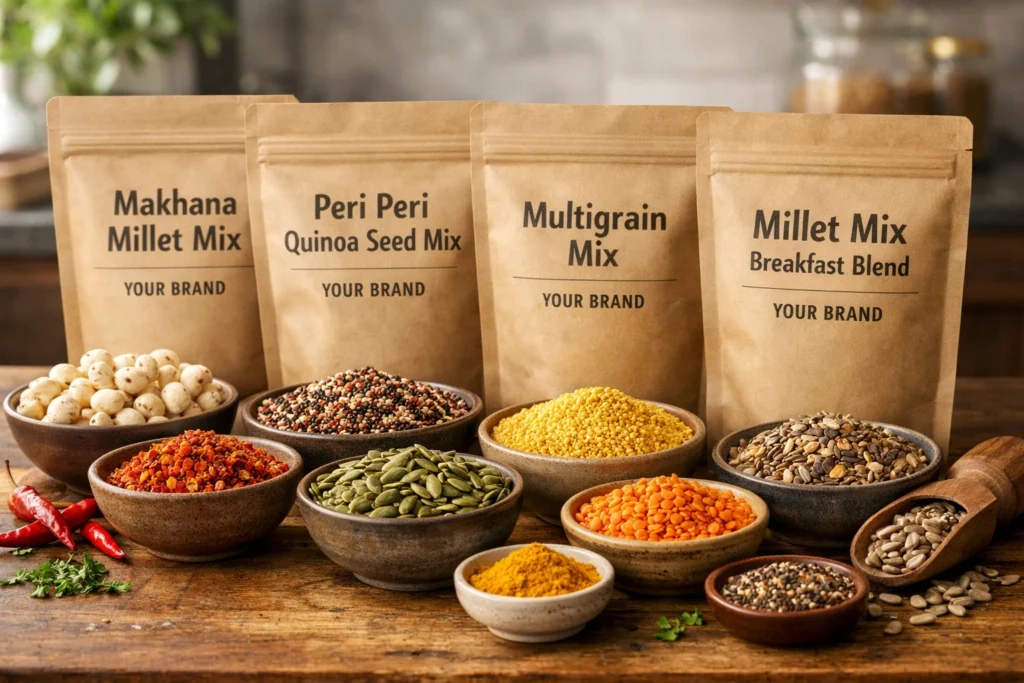
Building a successful snack range does not always mean creating one product and producing larger quantities. Modern brands can build stronger portfolios by offering the same core ingredient in multiple formats tailored to different customers, occasions, and sales channels.
A millet snack private label model gives brands the flexibility to develop such collections without establishing their own manufacturing infrastructure. Instead of treating millet as a single-product opportunity, businesses can use it as the foundation for a broader snack portfolio.
This approach allows brands to experiment with formats, flavours, pack sizes, and positioning while maintaining a recognisable product identity.
Why One Millet Base Can Support Multiple Snack Formats
Millets offer considerable flexibility for snack development. They can be incorporated into different product concepts depending on texture, preparation method, seasoning, and target audience.
A brand might develop:
- Roasted millet-based snacks
- Seasoned millet mixes
- Millet-based crunchy bites
- Millet snack blends
- Flavored grain combinations
- Portion-sized millet snack packs
- Premium millet snack collections
With millet snack private label, brands can organise these products under one portfolio instead of launching unrelated products individually.
The advantage is strategic consistency. Customers can recognise the brand while still having multiple products to choose from.
Designing Collections Around Consumer Occasions
A multi-format snack collection becomes more useful when every product serves a specific consumption occasion.
For example, a brand could create small packs for office snacking, larger packs for households, convenient portions for travel, and premium formats for gifting or specialty retail.
This gives millet snack private label a broader role than simple outsourced manufacturing. It becomes a product architecture strategy.
Brands can consider collections such as:
Everyday Range: Affordable, familiar flavors and practical pack sizes.
Premium Range: Distinctive seasoning combinations, upgraded packaging, and stronger positioning.
On-the-Go Range: Compact packs designed for convenience stores, travel, and workplace consumption.
Family Range: Larger packs suitable for household consumption and repeat purchases.
Each range can share a common millet-focused identity while targeting a different buying situation.
Using Flavor Architecture to Create Variety
Product variety does not necessarily require completely different ingredients. Flavor architecture can create meaningful differentiation within a collection.
A millet snack private label partner can help brands explore combinations such as savory, spicy, tangy, herb-based, or regionally inspired profiles.
The objective should be to create recognizable differences between products rather than simply adding random flavors.
For example, a portfolio could include a mild everyday option, a bold spicy variant, a tangy profile, and a premium herb-inspired product. This gives shoppers clear choices while keeping the overall collection connected.
Building Different Pack Sizes for Different Channels
Packaging strategy is another important part of multi-format snack development.
A product designed for online marketplaces may require a different pack configuration from one intended for supermarkets or specialty stores. Similarly, trial packs can encourage first-time purchases, while larger packs can support repeat customers.
Through millet snack private label, brands can plan product and packaging combinations around their intended sales channels.
Possible configurations include:
- Trial-size packs for sampling
- Single-serve packs for convenience
- Standard retail packs
- Multipacks for e-commerce
- Larger family packs
- Premium presentation packs
This approach helps brands avoid forcing one package format into every market.
Controlling Portfolio Complexity
Creating multiple products can also create operational challenges. Too many ingredients, packaging components, and production requirements can increase inventory complexity.
A smarter millet snack private label strategy begins with a controlled product architecture.
Brands can use shared ingredients, standardized packaging dimensions, common production processes, and a limited number of core seasoning systems wherever practical. This can make a multi-product portfolio easier to manage.
The goal is not to launch the maximum number of products. It is to create a well-structured collection where every SKU has a clear purpose.
Supporting Retail and E-Commerce Growth
Retailers often prefer product ranges that provide variety without unnecessary duplication. A coordinated millet collection can make it easier for a brand to present several products within one category.
For e-commerce, multiple formats can also support different search intents, price points, bundle opportunities, and promotional campaigns.
A millet snack private label strategy therefore allows brands to think beyond individual SKUs. Products can work together as a collection, encouraging cross-selling and repeat purchasing.
For example, customers discovering one millet snack online can also be introduced to another flavor, pack size, or format from the same brand.
Scaling the Collection Step by Step
Brands do not need to launch an entire portfolio immediately. A phased approach can reduce unnecessary investment.
The first stage can introduce two or three core products. Sales performance can then reveal which flavors, formats, and pack sizes deserve expansion.
Successful products can become anchor SKUs, while additional formats are developed around them.
This creates a practical growth cycle: launch, measure, refine, expand.
With the right millet snack private label partner, brands can move through these stages while keeping manufacturing, quality, packaging, and product development aligned.
How Annakosha Pvt. Ltd. Can Help?
Annakosha Pvt. Ltd. helps brands develop millet snack collections through private label manufacturing, supporting product formats, flavor development, packaging requirements, production planning, and scalable supply. Its approach allows businesses to build coordinated snack portfolios while focusing on branding, distribution, sales growth, and customer relationships instead of managing manufacturing operations internally.
FAQs
1. What is millet snack private label?
Millet snack private label allows a brand to sell millet-based snacks manufactured by another company under its own brand name and packaging.
2. Can millet snack private label support multiple products?
Yes. Brands can develop multiple formats, flavors, pack sizes, and product concepts within one coordinated millet snack collection.
3. Why create a multi-format millet snack range?
A multi-format range allows brands to target different consumer occasions, retail channels, price points, and purchasing preferences.
4. Can brands offer different flavors under one collection?
Yes. Brands can create several flavor profiles while maintaining a consistent overall product identity.
5. Is millet snack private label suitable for startups?
Yes. Private label manufacturing can help startups test selected products without investing in their own manufacturing facility.
6. Can millet snacks be sold through e-commerce?
Yes. Different pack sizes, multipacks, trial formats, and bundles can be developed for online selling.
7. How should brands decide which millet snack formats to launch?
Brands should evaluate their target audience, sales channel, pricing, consumption occasion, packaging requirements, and expected demand before selecting initial SKUs.
