
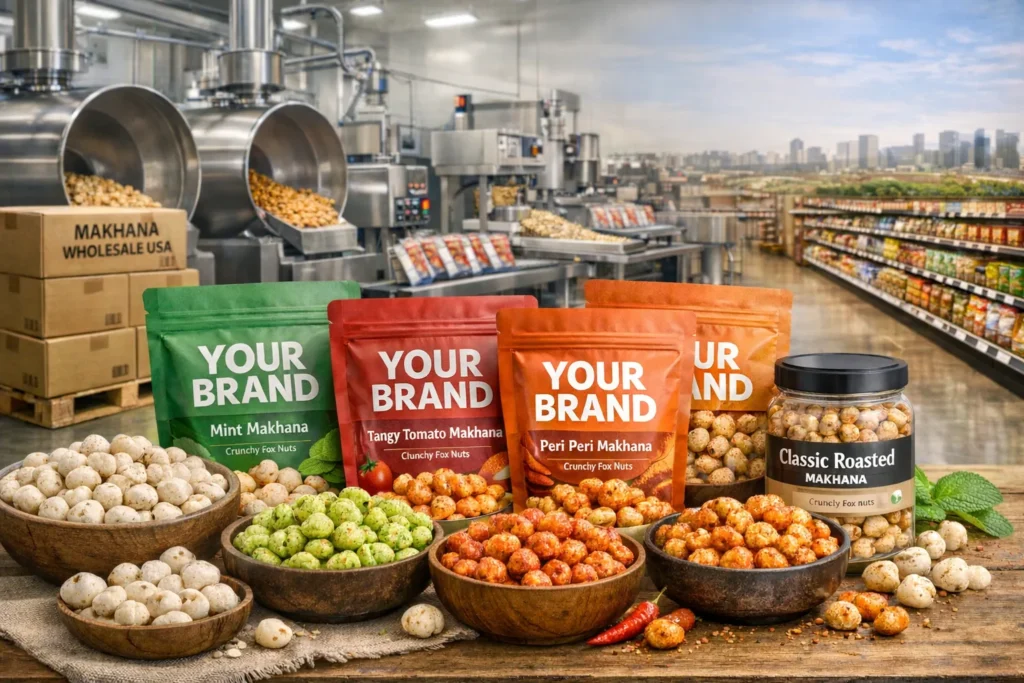
International dispersal of snack foods is more complex than launching a successful product. Companies planning a global roll-out need to plan for manufacturing, packaging, inventory, quality and logistics to ensure availability of their products across continents. Makhana has a growing position in the snacking landscape as a flexible snack ingredient, and presents brands with the potential to evolve differentiated products for overseas markets. Building international capabilities from within is unlikely to be the simplest approach. Partnering with a contract manufacturer for makhana offers brands the advantages of accessing domestic efficiencies while establishing a more streamlined base for global product dispersal.
Global Distribution Starts With Reliable Production
Retailers and distributors rely on the supplier to ensure products are always available and of the same quality. Production delays may lead to stock shortages, lost sales and difficulties in managing retailer relationships.
A contract manufacturer for makhana can support distribution planning through:
- Pre-arranged production schedules.
- Processes that are Repeatable in manufacture
- Planned batch production
- Joint packaging activities et des coordinations.
Reliable production links the manufacturing cells with their downstream distributors more firmly.
Manufacturing and Distribution Must Work Together
A common obstacle for emerging snack brands is viewing manufacturing and distribution as distinct entities. In practice, these two elements are deeply intertwined.
The volume of production, the number of packaging sizes to be supplied, stock levels and the delivery schedule all play a part in how quickly a product reaches a customer.
A professional contract manufacturer of makhana can work with other manufacturing demands to meet expected needs. This allows brands to prepare products over expansion cycles.
The integrated approach could also avoid additional process disruptions and increase supply transparency.
Scalable Production Supports International Growth
Yet a brand may introduce to a mass market in one country and then launch internationally. As a consequence, manufacturing capacity should be flexible with regard to demand.
A makhana contract manufacturer allows scaling up processes for an entrepreneurial business.
Brands can potentially move from:
Small market introduction→Regional distribution→Larger buying retail orders→Overseas expansion.
This means businesses can scale up production as the market develops without having to invest in infrastructure before need.
Packaging Plays a Critical Distribution Role
The packaging will need to safeguard the product and have the facilities to cater for easy flow of product through warehousing, transporting and sale. Off-putting packaging will cause avoidable problems within logistics.
By contract manufacturing, brands can also align packing needs with production by:
Various pack quantities
Retail-ready formats. Formats refer to the physical shape, form, or presentation of a product (e.g., shelf-ready, bulk, unitised, and pallet). The term retail-ready refers to the idea that the design and presentation of a product allow it to be placed directly on retail shelves.
Tailored brand packaging
Fit for shipment: Configurations that are shipment-friendly:
A robust packaging system can provide benefits in productivity at every level of distribution: warehouses, distributors, retailers and online shops.
Consistent Quality Across Multiple Markets
As snacks spread to different countries, retaining the same product experience becomes more crucial.
The contract manufacturer of makhana can develop specific procedures of processing, taste seasoning, packing and quality inspection.
Consistency helps brands maintain:
- Similar flavor profiles
- Same linear appearance
- Texture: Shown to be quite consistent.
- Stable packaging quality.
This, of course, becomes even more useful in the case where one product is released into multiple international markets.
Better Inventory Planning Reduces Distribution Pressure
High inventory leads to high storage costs, and low inventory might lead to shortages that can also influence profitability.
Manufacturing partners can improve their planning by matching production batch schedules to anticipated demand.
As for the brands that use a contract manufacturer for the makhana production, it gives them an opportunity to realise better co-ordination with:
Retail orders: Any orders received directly from bar 4 POS, other than those that are regarding delusions/substitutions but not about the transaction itself.
Distributor requirements: The following labels are not required or cannot be used by the distributor. Since they are in force now, but the distributor IS fails the criteria to use them. (Yes, they are.)
Seasonal demand
Market expansion plans: What are the plans for the business in terms of entering new markets in the future? What are the new markets that you would like to explore?
Enhanced planning can lead to a more seamless transition (smoother flow) from manufacturing plants to the point of sale.
Supporting Multiple Distribution Channels
Present-Day snack brands are not only present in supermarkets or hypermarkets but also available in specialty shops, online marts, through distributors or by direct sale to the consumer.
For example, clients may require different packaging as well as different order quantities for each channel. A flexible contract manufacturer for makhana can assist brands to ensure continuity of production while catering to different commercial formats.
This means that one manufacturing system is capable of catering for multiple sales channels, without the need for different production lines for each world market.
Reducing Operational Complexity for Growing Brands
Operating a plant involves capital for equipment, labor, maintenance, quality systems, raw materials and production planning.
For brands with significant focus on international sales, this can lead to staff diverting their attention to these activities and subsequently taking resources away from market development.
Having a contract manufacturer for makhana essentially takes away a lot of the manufacturing issues to an experienced production partner.
Brands can therefore focus more on:
Relationships with distributors: Building user relations that are flexible and meet the needs of all users as well as the department.
Retail expansion [9]. The Long tail, such as I Am, was responsible for about 20% of book sales on Amazon [10]. In the United States, the percentage of popular titles in the bookstore is only around 55-65 % [11]. It can be assumed that this number is even lower in Europe.
Marketing
Customer acquisition18Product AdoptionOnce the customer makes the purchase, the salesperson continues to serve them through the entire Product Adoption process. Essentially, the salesperson is responsible for guiding the customer through the stages of the product adoption bell curve.
European Market Research: The large European market offers excellent opportunities; therefore, we carry out market research on the European market. As there are different markets in European countries, we have to do detailed research for each country.
Supporting Faster Market Expansion
International expansion often leads to swift decisions when a new retail opportunity arises. A brand that is unable to manufacture enough stock will have difficulties seizing a new retail partnership.
During tight production capacity, a contract manufacturing model may be able to contribute to the additional production support required to cater to the escalating demands.
Having established processes and scalable capabilities, a contract manufacturer of makhana can prepare brands for increased orders without compromising the quality standards set.
Creating a More Resilient Supply Structure
The global distribution chain is wide-ranging and includes the sourcing, processing, packaging, warehousing, transportation and finally retail delivery. If a weakness is identified at any one point, then the whole chain can be jeopardised.
A reliable manufacturing partner can help to enhance the manufacturing stage by establishing a systematic process and consistent output.
This gives a more resilient basis for brands building long-term international distribution systems.
Why the Right Manufacturing Partner Matters
Not all contract manufacturers are created equal. A brand should assess the production capacity, quality system, customizable options, packaging know-how, communication and sourcing ability of a prospective partner beforehand.
The most appropriate contract manufacturer for makhana will be one that evolves to provide us with a reliable extension of, not merely a manufacturer of, the makhana brand.
A good working relationship not only ensures the short-term needs of the product produced but also provides an avenue for long-term international expansion.
How Annakosha Pvt. Ltd. Can Help? (50 Words)
Annakosha Pvt. Ltd. helps brands with contract manufacturing of makhana, which can cater to their needs in terms of volume and flavours, processed under strict quality standards, fully packed and ready for retail and assured supply chain management. Our manufacturing strength enables companies to take care of increasing order batches, ensure quality compliance and strengthen and expand the distribution of makhana snacks within the country and around the Globe.
FAQs
1. What is a contract manufacturer for makhana?
A contract manufacturer for makhana makes snack products with makhana for brands as per the stipulated product composition, packaging, quality, and production specifications.
2. How can contract manufacturing support global distribution?
Ensures organised production, expandable capacity, consistent quality and packaging support that may enable brands to sustain their product availability among different markets.
3. Can a contract manufacturer produce customised makhana snacks?
Yes. Brand owners can cooperate with manufacturers to develop tailor-made flavours, pack sizes, specifications and branding by market.
4. Is contract manufacturing suitable for growing snack brands?
Yes. It provides emerging brands with access to ready-to-go manufacturing facilities without having to build a facility of their own.
5. What should brands consider when choosing a contract manufacturer for makhana?
Brands need to consider production capacity, quality control, possibility of customizations, packaging capacity, scalability, reliability of supplies and experience of supporting domestic and international markets.
