
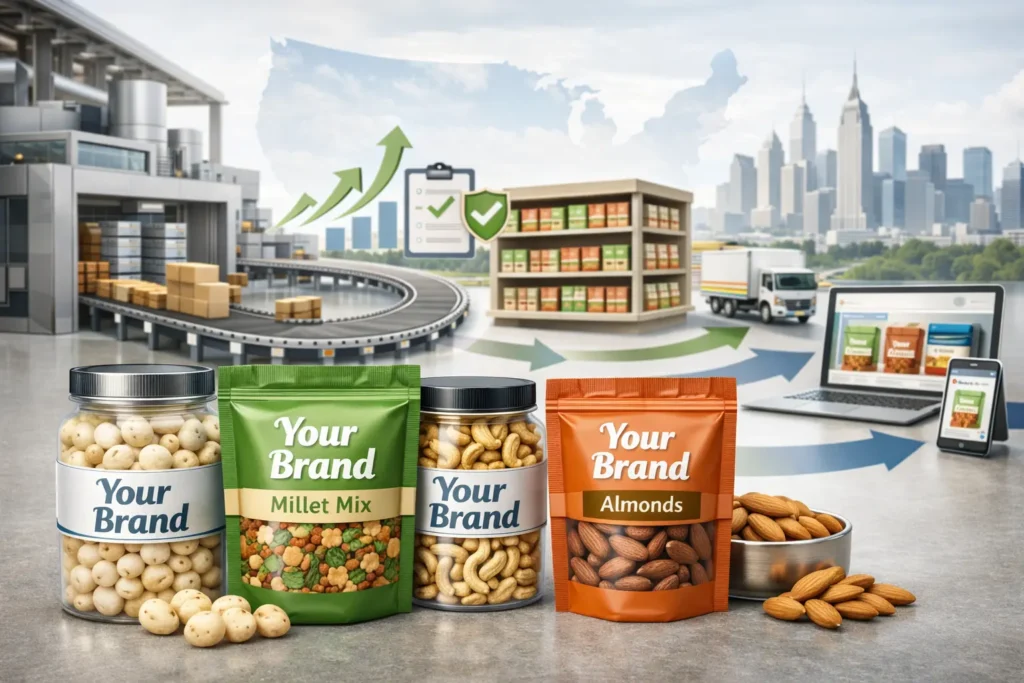
Start a Snack Brand USA today has less to do with owning factories and more to do with making smart structural decisions early. Entrepreneurs who succeed in the American snack market focus on speed, compliance, and brand positioning—areas where private label snacks offer a major advantage.
Below are 7 practical, execution-focused steps to start a snack brand USA using private labeling, designed for founders who want faster market entry with controlled risk.
Step 1: Define a Clear Snack Category and Buyer Persona
Before product selection, clarity matters. The U.S. snack market is crowded, and broad positioning weakens brand identity. Decide early:
-
Who your ideal buyer is
-
When and why they consume snacks
-
What problem your snack solves
A focused category—such as plant-based snacks, ancient grains, or clean-label options—creates instant relevance when you start a snack brand USA.
Step 2: Choose Private Label Snacks That Match Market Demand
Private label snacks allow you to launch with proven product formats instead of experimenting blindly. Look for products that already align with U.S. consumption habits, shelf life expectations, and portion sizing.
This step reduces development time while ensuring your offerings are market-ready from day one.
Step 3: Ensure Regulatory Readiness Before Branding
One of the biggest mistakes new founders make when they start a snack brand USA is branding before compliance. Packaging design, claims, and ingredient disclosures must align with U.S. food regulations.
Private label partners with regulatory experience help ensure:
-
Ingredient transparency
-
Accurate nutritional panels
-
Compliant labeling formats
This prevents costly redesigns and delayed launches.
Step 4: Build a Brand Story Around Value, Not Just Taste
Taste alone does not build loyalty in the U.S. market. Successful snack brands communicate purpose—whether it’s clean nutrition, sustainability, or convenience.
When you start a snack brand USA, your brand story should clearly answer:
-
Why this snack exists
-
What makes it different
-
Why consumers should trust it
Private labeling frees up time and resources to focus on storytelling instead of production issues.
Step 5: Finalize Packaging for Multi-Channel Selling
Packaging should support both online and offline channels from the beginning. Consider:
-
Durability for shipping
-
Shelf visibility for retail
-
Clear messaging for quick buying decisions
Private label snacks are often designed to meet multi-channel standards, making expansion easier without changing formats later.
Step 6: Plan a Phased Market Entry Strategy
Instead of launching everywhere at once, a phased approach works best when you start a snack brand USA. Begin with:
-
DTC or marketplace platforms
-
Regional distributors
-
Select retail placements
This approach allows real-time feedback and controlled scaling, reducing inventory and marketing risks.
Step 7: Scale Using Data, Not Assumptions
Once sales begin, data becomes your strongest asset. Track:
-
Repeat purchase behavior
-
Top-performing SKUs
-
Channel-wise demand
Private label snacks allow quick adjustments in volume, packaging, or variants based on actual performance rather than guesswork.
Why Private Label Snacks Simplify the Process
Private labeling compresses years of operational learning into a structured system. Instead of managing sourcing, production, and quality control independently, founders can focus on:
-
Customer acquisition
-
Brand building
-
Distribution growth
This is why many modern founders start a snack brand USA with private label models instead of traditional manufacturing.
FAQs
1. Is private labeling suitable for first-time founders?
Yes, it simplifies production and compliance, allowing founders to focus on branding and sales.
2. How fast can I start a snack brand USA with private labeling?
Timelines are significantly shorter compared to in-house manufacturing, often within months.
3. Do private label snacks limit brand creativity?
No, brands retain full control over branding, positioning, and market strategy.
4. Can private label snacks scale with growing demand?
Yes, private labeling is designed for flexible volume scaling and multi-channel growth.
