
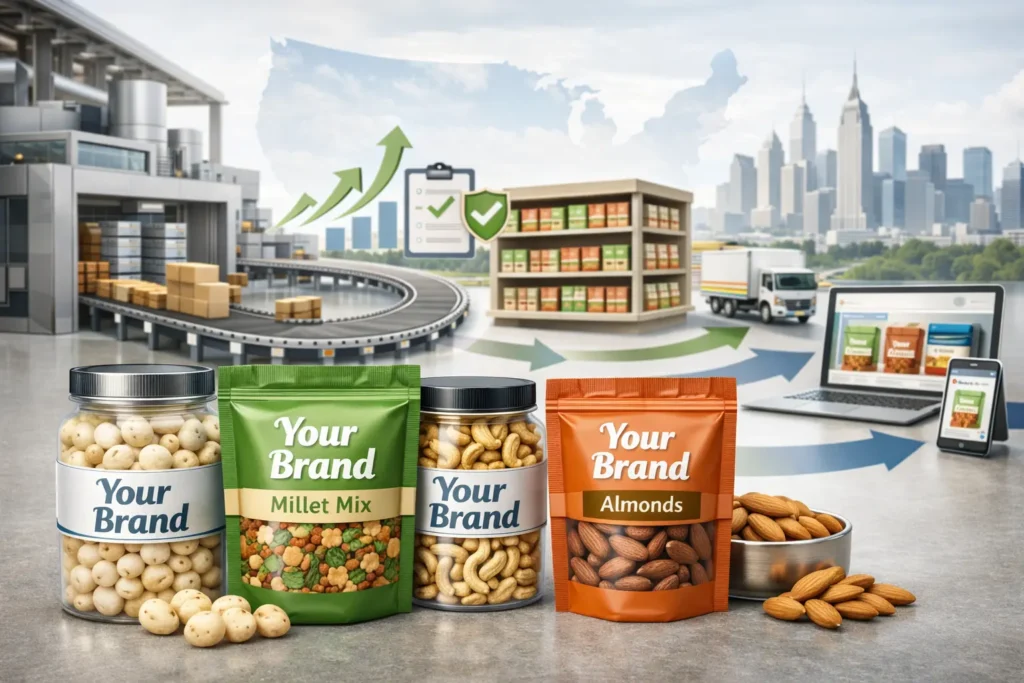
In the snack business USA market, innovation is often overrated. While unique flavors and concepts attract attention, they rarely guarantee success. What consistently separates winning snack brands from struggling ones is speed-to-shelf—the ability to move from idea to retail-ready product faster than competitors.
The US snack industry is highly timing-driven. Retail windows, trend cycles, and buyer calendars move quickly. Brands that reach shelves at the right moment capture demand, while slower innovators often miss it entirely.
The Reality of the Snack Business USA Market
The snack business USA operates on velocity. Retailers evaluate products based on how fast they sell, not how innovative they sound. A moderately differentiated product launched quickly often outperforms a highly innovative product launched late.
Speed-to-shelf impacts:
-
Retail buyer confidence
-
Early sales velocity
-
Distribution expansion opportunities
In many cases, execution speed defines market relevance more than originality.
Why Innovation Alone Slows Growth
Innovation adds complexity. New ingredients, unfamiliar processing methods, and untested packaging increase approval timelines. In the snack business USA, every added complexity delays shelf entry.
Slow innovation leads to:
-
Extended compliance reviews
-
Production trial failures
-
Missed seasonal demand
Brands that prioritize speed focus on proven formats with controlled differentiation rather than experimental innovation.
Retail Timing Is a Competitive Advantage
Retail buyers plan assortments months in advance. Brands that are ready when buyers review categories gain shelf access—even if their products are not radically new.
In the snack business USA, speed-to-shelf allows brands to:
-
Enter new planograms faster
-
Replace underperforming SKUs
-
Secure trial placements
Timing alignment often matters more than novelty.
Faster Brands Learn From the Market Sooner
Speed-to-shelf doesn’t mean skipping learning—it means learning faster. Brands that launch quickly collect real sales data earlier, enabling faster optimization.
This creates advantages such as:
-
Rapid flavor refinement
-
Smarter pricing decisions
-
Packaging improvements based on real feedback
In the snack business USA, market feedback is more valuable than internal assumptions.
Supply Readiness Drives Speed
Speed-to-shelf is impossible without supply readiness. Brands that succeed build around manufacturing capabilities instead of forcing factories to adapt.
Key enablers include:
-
Standardized formulations
-
Readily available ingredients
-
Scalable packaging formats
When supply systems are aligned early, brands enter the snack business USA market with fewer launch delays.
Compliance Delays Kill Momentum
Many snack brands lose momentum due to labeling corrections, documentation gaps, or regulatory misalignment. Speed-focused brands prepare compliance in parallel with product development.
This approach ensures:
-
Faster approvals
-
Fewer relaunches
-
Smooth retailer onboarding
In the snack business USA, compliance readiness directly accelerates speed-to-shelf.
Speed Reduces Financial Risk
Long development cycles burn capital before revenue begins. Brands that launch faster validate demand sooner and reduce cash exposure.
Speed-to-shelf helps brands:
-
Control upfront investment
-
Test multiple SKUs quickly
-
Allocate marketing budgets wisely
In the snack business USA, fast validation protects long-term profitability.
How Annakosha Pvt. Ltd. Helps
Annakosha Pvt. Ltd. helps snack business USA brands accelerate speed-to-shelf through ready manufacturing systems, compliant formulations, scalable packaging, and export-ready processes. Our private label model minimizes development delays, enabling faster launches, quicker retail entry, and lower early-stage risk.
FAQs
1. Why is speed-to-shelf critical in the snack business USA?
Because retail cycles move fast and consumer trends change quickly. Delayed launches often miss demand windows.
2. Does faster launch mean lower quality?
No, speed comes from process readiness, not shortcuts. Prepared brands maintain quality while launching faster.
3. Are innovative snacks still important?
Yes, but controlled innovation works better than radical experimentation in early growth stages.
4. How do retailers view fast-launch brands?
Retailers prefer brands that can execute reliably and meet timelines with minimal friction.
5. Can speed-to-shelf improve scaling?
Absolutely, faster launches lead to quicker feedback, stronger velocity, and easier expansion.
