
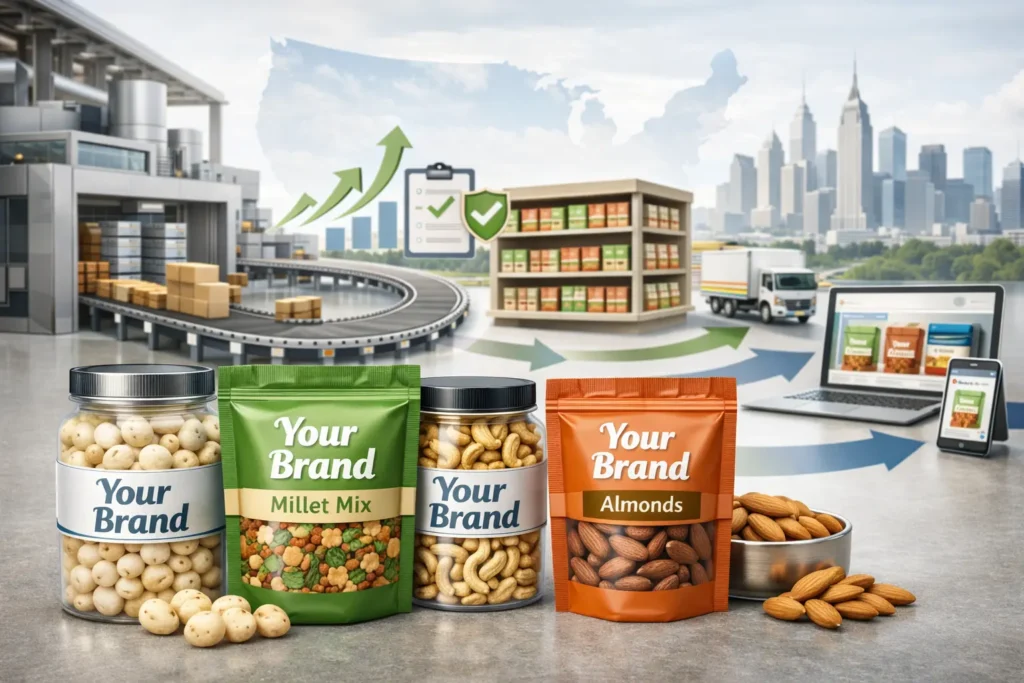
In the snack business USA, great ideas are common—but consistent execution is rare. Thousands of brands launch each year, yet only a small fraction survive long enough to reach stable retail distribution.
The reason is not demand. It’s structure. Most failures occur when brands attempt to scale before building operational discipline. Private labeling succeeds because it introduces structure early, allowing brands to grow without operational chaos.
Stage 1: Market Entry Without Capital Burn
For new entrants, the snack business USA presents high upfront costs—equipment, facilities, compliance setup, and sourcing complexity. These barriers slow launches and drain capital before traction is proven.
Private labeling removes these friction points by allowing brands to:
-
Enter the market without owning production assets
-
Test demand with controlled batch sizes
-
Launch faster with ready manufacturing systems
-
Preserve capital for branding and sales
At this stage, speed and flexibility matter more than ownership.
Stage 2: Early Growth With Controlled Risk
Once a snack brand gains traction, the challenge shifts from launching to delivering reliably. Missed timelines, inconsistent quality, or cost overruns can stall momentum quickly.
Private labeling supports early growth by offering:
-
Scalable production volumes
-
Predictable per-unit costs
-
Stable quality benchmarks
-
Process repeatability
Instead of firefighting manufacturing issues, brands can focus on customer acquisition and channel partnerships.
Stage 3: Retail Readiness in the Snack Business USA
Retail expansion is where many snack brands struggle. US retailers demand reliability—on-time delivery, consistent packaging, and compliance documentation.
Private label systems are designed for retail readiness. They help brands:
-
Meet retailer onboarding requirements
-
Maintain uniform product specifications
-
Support larger purchase orders
-
Avoid supply disruptions
Retail buyers trust systems more than startups, and private labeling provides that system-level credibility.
Stage 4: Scaling Without Operational Bottlenecks
As distribution expands, complexity increases. More SKUs, more regions, and higher volumes introduce risk if manufacturing is not designed to scale.
Private labeling allows snack business USA brands to:
-
Increase volume without rebuilding infrastructure
-
Launch variations without new production lines
-
Maintain consistency across geographies
-
Scale incrementally instead of all at once
This modular scalability is what keeps growth sustainable.
Stage 5: Margin Protection at Higher Volumes
At scale, profitability becomes more important than speed. Brands that built in-house manufacturing often face margin erosion due to inefficiencies and rising overheads.
Private labeling protects margins by:
-
Sharing infrastructure costs
-
Optimizing procurement at scale
-
Reducing waste and downtime
-
Converting fixed costs into variable costs
This financial efficiency becomes a long-term competitive advantage.
Why Private Labeling Aligns With Modern Snack Brands
The modern snack business USA is marketing-led, data-driven, and consumer-focused. Brands win by understanding demand, not by managing factories.
Private labeling enables this by:
-
Separating brand strategy from manufacturing execution
-
Allowing faster pivots based on market feedback
-
Supporting omnichannel distribution
-
Reducing distraction from core growth activities
Ownership of the brand—not the plant—is what drives value today.
How Annakosha Pvt. Ltd. Can Help?
Annakosha Pvt. Ltd. supports snack business USA brands through scalable private label manufacturing, retail-ready compliance systems, and consistent quality control. We help brands move smoothly from launch to growth to expansion—without forcing them to absorb operational risk or infrastructure complexity.
FAQs
1. What is the biggest challenge in the snack business USA?
Operational scalability. Many brands fail due to inconsistent supply, compliance gaps, and rising costs during growth.
2. How does private labeling help new snack brands?
It enables fast market entry with lower capital investment and built-in manufacturing systems.
3. Is private labeling suitable for large-scale snack businesses?
Yes, it supports high-volume production while maintaining cost control and consistency.
4. Can private labeling support retail expansion?
Absolutely, private label systems are designed to meet retailer expectations and compliance standards.
5. Does private labeling limit brand control?
No, brands retain full ownership of branding, pricing, and market strategy.
