
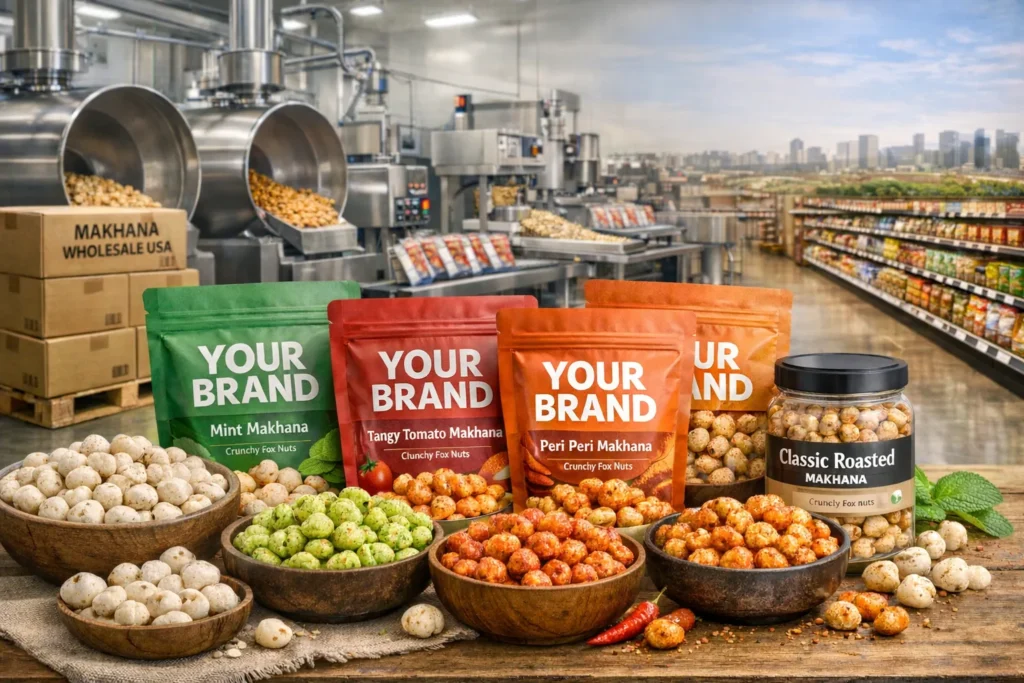
Private label makhana manufacturer partnerships are becoming a strategic foundation for brands entering the growing US makhana snack market. As demand increases for clean-label, protein-rich, and low-fat snacks, more brands are launching quickly—but only those focused on sustainable execution scale successfully. Rather than treating sourcing as a one-time transaction, growth-oriented brands select a private label makhana manufacturer as a long-term partner. This approach ensures consistency, scalability, and reliability, separating short-lived launches from snack brands built for lasting success in competitive retail environments.
Why Transactional Manufacturing Limits Brand Potential
Many snack startups begin with price-focused sourcing. While this may work for initial testing, it creates long-term risks:
-
Inconsistent product quality across batches
-
Limited ability to scale volumes during demand spikes
-
Delays in compliance documentation for U.S. retail
-
No structured R&D or product evolution support
A private label makhana manufacturer that operates only as a vendor focuses on output, not outcomes. Growth-stage brands need deeper alignment.
The Growth Partner Mindset Explained
A true private label makhana manufacturer functions as a growth partner by aligning with your brand’s long-term objectives rather than individual purchase orders. This partnership model focuses on systems, predictability, and scalability.
Key elements of this mindset include:
-
Long-term sourcing strategies for stable raw material quality
-
Standardized roasting and seasoning protocols
-
Forecast-based production planning
-
Regulatory readiness for U.S. food authorities
This approach reduces operational surprises and allows brands to focus on marketing, distribution, and customer loyalty.
Consistency Is the Real Differentiator in Makhana Brands
In the U.S. snack aisle, consistency drives repeat purchases. Texture, crunch, flavor balance, and shelf stability must remain identical across every batch.
A private label makhana manufacturer with standardized SOPs, quality checks, and batch traceability ensures:
-
Uniform sensory experience for consumers
-
Lower return rates from distributors
-
Stronger retailer confidence
Consistency is not accidental—it’s engineered through systems and long-term manufacturing discipline.
Scaling Without Compromising Quality
As brands grow, volume increases often expose weak manufacturing relationships. A growth-focused private label makhana manufacturer plans scalability from day one.
This includes:
-
Flexible production capacity
-
Multi-shift readiness for peak demand
-
Buffer inventory strategies
-
Packaging scalability for retail and e-commerce
When scaling is built into the partnership, brands avoid the common trap of outgrowing their manufacturer.
Compliance as a Growth Enabler, Not a Barrier
FDA compliance is not just a regulatory requirement—it’s a growth tool. Retail chains, distributors, and investors demand it.
A reliable private label makhana manufacturer supports:
-
Proper labeling and nutritional documentation
-
Allergen control and traceability
-
Export-readiness for U.S. entry
Compliance handled at the manufacturing level reduces risk, speeds onboarding with retailers, and builds brand credibility.
Innovation Comes From Collaboration, Not Guesswork
The makhana category is evolving—new flavors, formats, and blends are shaping consumer demand. Manufacturers focused only on production cannot support innovation.
A growth-aligned private label makhana manufacturer contributes by:
-
Testing seasoning stability
-
Improving roasting efficiency
-
Supporting clean-label reformulations
-
Adapting products to U.S. taste preferences
Innovation becomes structured, repeatable, and data-backed.
Cost Control Through Long-Term Planning
Short-term sourcing often leads to volatile pricing. A private label makhana manufacturer invested in partnership uses long-term procurement planning to stabilize costs.
Benefits include:
-
Predictable pricing models
-
Reduced wastage
-
Optimized yield per batch
-
Better margin planning for brands
Cost efficiency becomes sustainable, not reactive.
How Annakosha Pvt. Ltd. Can Help?
Annakosha Pvt. Ltd. operates as a private label makhana manufacturer focused on long-term partnerships. With standardized processes, scalable production, FDA-aligned systems, and innovation support, Annakosha helps snack brands in the USA build consistency, control costs, and grow confidently from launch to expansion.
FAQs
1. What makes a private label makhana manufacturer a growth partner?
A growth partner aligns manufacturing systems with your brand’s long-term goals, ensuring scalability, consistency, and compliance—not just production.
2. Is private label makhana suitable for the U.S. market?
Yes, makhana fits U.S. demand for clean-label, plant-based, low-fat snacks when produced under FDA-compliant systems.
3. Can a private label makhana manufacturer help with compliance?
Absolutely, experienced manufacturers support FDA documentation, labeling standards, and quality controls essential for U.S. retail entry.
4. How does long-term manufacturing reduce costs?
Through stable sourcing, optimized production, and reduced wastage, long-term partnerships offer predictable pricing and better margins.
5. When should a brand shift from a vendor to a growth partner?
Ideally before scaling. Early alignment prevents operational bottlenecks and quality risks as demand increases.
