
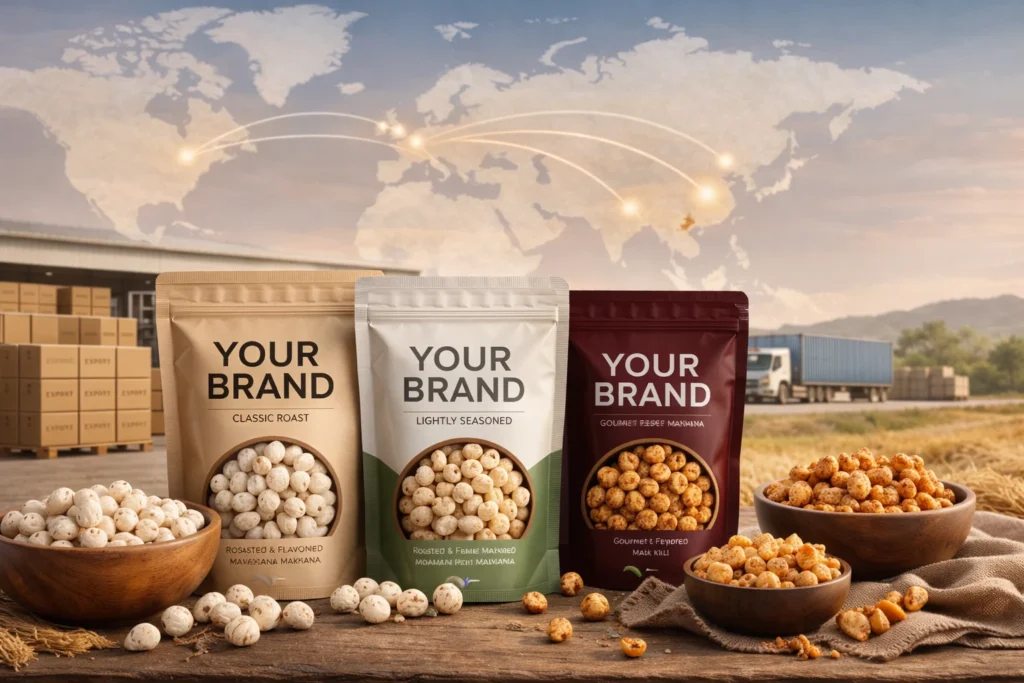
Makhana wholesale USA operations are expanding rapidly as fox nuts gain traction across health, gourmet, and functional snack categories. However, scaling in the U.S. market comes with hidden risks—supply volatility, inconsistent quality, regulatory pressure, and margin erosion.
Private label manufacturing offers more than speed. When executed strategically, it becomes a risk-elimination framework that protects brands as volumes, channels, and geographies expand.
Below are eight private label strategies that help brands scale makhana wholesale USA operations without operational instability.
1. Locking Raw Material Specifications Early
One of the biggest scaling risks in wholesale is inconsistency. Size variation, moisture imbalance, and raw material grading issues quickly surface at higher volumes.
Private label partners reduce this risk by:
-
Fixing raw makhana grade specifications
-
Implementing incoming quality benchmarks
-
Rejecting non-compliant batches
This ensures uniformity across wholesale and retail orders.
2. Centralized Processing Instead of Multi-Vendor Sourcing
Brands sourcing makhana from multiple processors often face taste and texture variations. Private labeling centralizes processing under one controlled system.
Benefits include:
-
Uniform roasting profiles
-
Standardized seasoning adhesion
-
Predictable shelf-life outcomes
This is critical for U.S. distributors who expect batch-to-batch consistency.
3. Demand-Aligned Production Planning
Overproduction leads to stale inventory. Underproduction results in stockouts—both damaging in the U.S. wholesale ecosystem.
Private label models reduce this risk by aligning:
-
Production cycles with confirmed forecasts
-
Batch sizes with channel-specific demand
-
Inventory flow with distributor timelines
This keeps working capital optimized.
4. Built-In Compliance Safeguards
Scaling makhana wholesale USA without regulatory readiness is a major risk. Retailers and importers require accurate labeling, traceability, and safety documentation.
Private label manufacturing embeds:
-
Batch traceability systems
-
Export-ready documentation
This prevents costly shipment rejections or recalls.
5. Packaging Formats Designed for Wholesale Logistics
Retail-friendly packaging doesn’t always work for wholesale distribution. Private labeling allows brands to design packaging that protects product integrity during long supply chains.
This includes:
-
Moisture-resistant materials
-
Stackable, transport-efficient formats
-
Shelf-life optimized sealing
Packaging becomes a risk-control tool, not just a marketing asset.
6. Scalable Cost Structures Without Margin Erosion
As volumes increase, hidden costs often emerge—labor inefficiencies, raw material price swings, or logistics overruns.
Private label manufacturing stabilizes costs through:
-
Bulk procurement advantages
-
Optimized production workflows
-
Predictable per-unit pricing
This protects margins even during rapid expansion.
7. SKU Expansion Without Operational Chaos
Scaling often means launching new flavors, pack sizes, or market-specific variants. Without structured systems, this creates operational strain.
Private label partners support SKU expansion by:
-
Managing parallel production lines
-
Maintaining formulation control
-
Ensuring quality consistency across variants
Brands grow portfolios without disrupting core operations.
8. Risk-Sharing Through Long-Term Manufacturing Partnerships
Unlike transactional sourcing, private labeling creates long-term alignment. Manufacturers plan capacity, sourcing, and manpower based on brand growth.
This shared planning:
-
Reduces supply shocks
-
Improves responsiveness to demand spikes
-
Builds long-term operational resilience
Scaling becomes predictable, not reactive.
How Annakosha Pvt. Ltd. Helps
Annakosha Pvt. Ltd. supports makhana wholesale USA brands by offering private label manufacturing with controlled sourcing, standardized processing, scalable capacity, and export-ready systems. Their approach minimizes supply, quality, and compliance risks—allowing brands to expand wholesale and retail distribution with confidence and operational stability.
FAQs
1. What does makhana wholesale USA mean?
It refers to sourcing, processing, and distributing fox nuts in bulk for the U.S. market through wholesale and retail channels.
2. Why is private labeling important for scaling wholesale?
Private labeling centralizes quality, compliance, and production planning, reducing risks associated with multi-vendor sourcing.
3. Can private label makhana be sold in U.S. retail stores?
Yes, private label products are designed to meet retail packaging, labeling, and safety requirements.
4. Does private labeling reduce operational risk?
Yes, it eliminates inconsistencies, stabilizes costs, and embeds compliance into production workflows.
5. Is private labeling suitable for high-volume distribution?
Absolutely, it is specifically designed to support scalable, repeatable, and predictable production at volume.
