
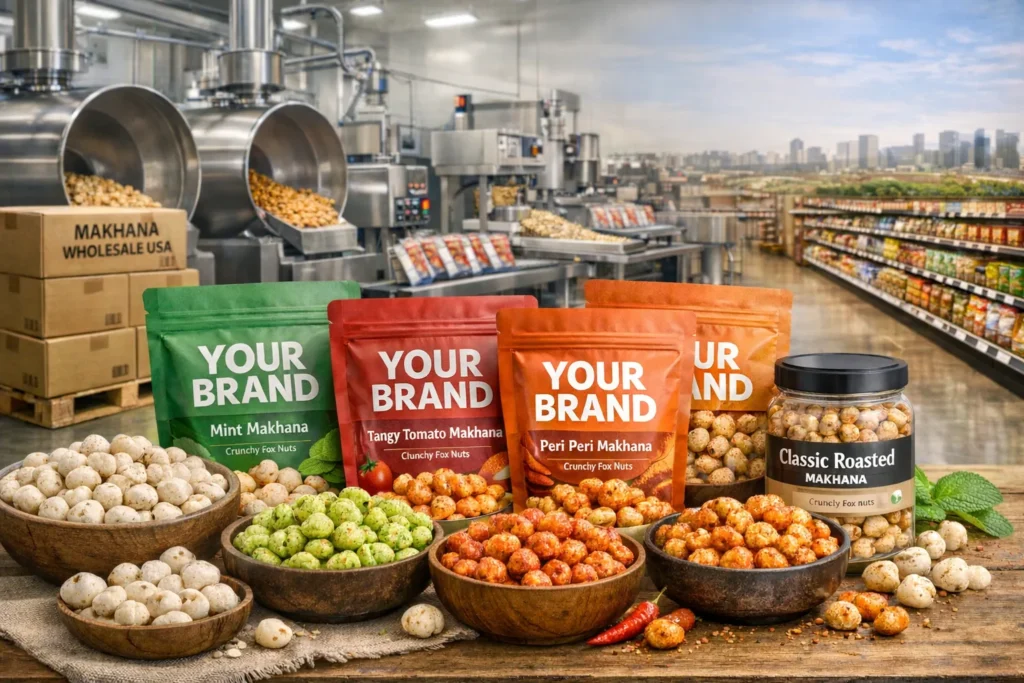
A contract manufacturer for makhana plays a critical role in stabilizing supply chains for snack brands operating in fast-moving, quality-sensitive markets. While fox nuts are gaining global demand, managing their sourcing, processing, and delivery at scale presents multiple operational challenges—especially for brands without manufacturing infrastructure.
From raw material inconsistency to unpredictable lead times, supply issues can directly impact product quality, margins, and retailer confidence. Contract manufacturing offers a structured solution to these challenges by professionalizing every stage of the makhana supply chain.
Below are six of the most common supply challenges brands face—and how a contract manufacturer for makhana resolves them.
1. Inconsistent Raw Material Quality
Makhana is an agricultural product, and quality can vary significantly across regions, seasons, and suppliers. Differences in size, moisture, and maturity affect roasting behavior and shelf life.
A contract manufacturer for makhana addresses this by:
-
Working with vetted sourcing networks
-
Implementing grading and sorting standards
-
Rejecting sub-standard raw material before processing
This ensures only retail-grade makhana enters production, protecting final product consistency.
2. Supply Interruptions and Stock Gaps
Brands sourcing makhana independently often face supply disruptions caused by seasonality, fragmented suppliers, or poor inventory planning. These gaps can lead to missed orders and retailer penalties.
Contract manufacturers mitigate this risk through:
-
Forecast-based procurement planning
-
Buffer inventory management
-
Long-term supplier relationships
This structured approach ensures uninterrupted production even during demand spikes.
3. Unstable Roasting and Processing Output
Makhana processing requires precise control of temperature, time, and moisture. Inconsistent roasting leads to uneven crunch, burnt kernels, or reduced shelf life.
A contract manufacturer for makhana solves this with:
-
Standardized roasting protocols
-
Calibrated equipment
-
Process-level quality checkpoints
These controls create uniform taste and texture across every batch.
4. Scaling Production Without Operational Chaos
As brands grow, scaling production becomes complex. Increasing volume without disrupting quality or timelines is difficult without professional systems.
Contract manufacturing enables scalable growth by:
-
Offering flexible batch sizes
-
Planning capacity expansion in advance
-
Maintaining consistency at higher volumes
Brands can scale up or down without operational strain or capital investment.
5. Packaging Delays and Compatibility Issues
Packaging is often a hidden bottleneck. Incorrect material selection, sealing failures, or incompatible pack sizes can delay dispatches and affect shelf life.
A contract manufacturer for makhana manages packaging by:
-
Testing material compatibility with roasted makhana
-
Ensuring moisture and oxygen barriers
-
Aligning packaging formats with logistics needs
This results in smoother dispatch cycles and reduced post-production issues.
6. Compliance and Documentation Gaps
Supplying organized retail or export markets requires detailed documentation, batch traceability, and regulatory alignment. Many brands struggle to maintain this independently.
Contract manufacturers provide built-in compliance through:
-
Batch-level records
-
Labeling and traceability systems
This support reduces regulatory risk and speeds up market approvals.
Operational Stability as a Competitive Advantage
Supply reliability is no longer a backend concern—it directly impacts brand reputation, retailer relationships, and growth potential. By partnering with a contract manufacturer for makhana, brands replace uncertainty with predictable operations.
Instead of firefighting supply issues, teams can focus on sales, marketing, and expansion while production runs smoothly in the background.
How Annakosha Pvt. Ltd. Helps
Annakosha Pvt. Ltd. supports brands as a reliable contract manufacturer for makhana by managing sourcing, processing, quality control, scalable production, and compliant packaging. Their structured supply systems reduce operational risks, stabilize inventory flow, and help brands maintain consistent product quality across growing domestic and international markets.
FAQs
1. What does a contract manufacturer for makhana do?
They handle sourcing, processing, roasting, seasoning, packaging, and quality control for makhana products supplied under a brand’s name.
2. How does contract manufacturing reduce supply risks?
It centralizes sourcing, standardizes processes, and introduces forecasting systems that prevent stock gaps and inconsistencies.
3. Is contract manufacturing suitable for growing brands?
Yes, it allows brands to scale production without investing in factories, labor, or equipment.
4. Can contract manufacturers support exports?
Absolutely, they manage compliance, documentation, and batch traceability required for international markets.
5. Does contract manufacturing limit brand control?
No, brands retain full control over branding, pricing, and positioning while manufacturing is professionally managed.
