
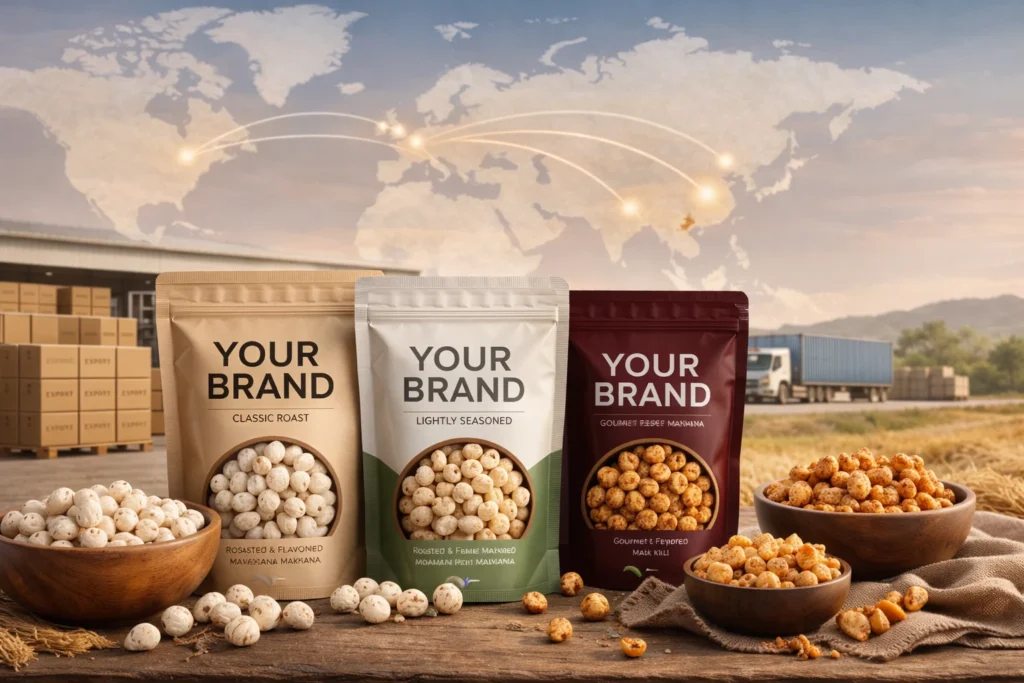
The makhana wholesale USA market is expanding rapidly, driven by clean-label snacking, plant-based diets, and demand for functional foods. However, many suppliers still approach this market with a bulk-first mentality—focusing only on tonnage, pricing, and container loads. That approach is increasingly misaligned with how US retail actually works.
In the United States, wholesale buyers don’t just buy ingredients; they buy retail readiness. From national grocery chains to regional distributors and private-label snack brands, expectations are far more structured. Volume is just the starting point, not the differentiator.
Why Volume-Only Suppliers Struggle in the US Market
Supplying makhana wholesale USA is not the same as supplying to domestic or traditional trade markets. Retail ecosystems in the US are compliance-driven and performance-oriented.
Common challenges faced by volume-led suppliers include:
-
Inconsistent kernel size and popping quality
-
Variable moisture levels impacting shelf life
-
Lack of standardized grading systems
-
Absence of US-compliant documentation
-
Packaging formats unsuitable for retail distribution
When these gaps exist, even competitively priced bulk makhana fails to convert into long-term retail relationships.
Retail Buyers Demand Predictability, Not Just Price
In makhana wholesale USA, predictability matters more than marginal cost savings. Retail buyers want assurance that every shipment will meet the same quality benchmarks month after month.
Key expectations include:
-
Uniform size grading for consistent roasting
-
Low breakage percentage for higher yield
-
Stable moisture control for extended shelf life
-
Food safety certifications aligned with US norms
Without these fundamentals, suppliers risk returns, delisting, or stalled reorder cycles—regardless of how large their volume capacity is.
Packaging Readiness Is a Wholesale Requirement Now
Modern makhana wholesale USA buyers increasingly expect suppliers to support retail-compatible packaging, even at the wholesale stage. This includes:
-
Clear bulk packaging specifications
-
Inner liners to protect freshness
-
Labeling compatibility for private labeling
-
Traceability and batch identification
Wholesale no longer means “unbranded sacks.” It means packaging that integrates smoothly into retail, co-packing, or private-label workflows.
Certifications and Compliance Are Non-Negotiable
For the US market, documentation is not an afterthought—it’s a gatekeeper. Successful makhana wholesale USA suppliers proactively align with regulatory and buyer requirements such as:
-
Residue and contamination controls
-
Clear country-of-origin traceability
-
Consistent lab testing protocols
Buyers prioritize suppliers who reduce compliance friction rather than create it.
The Shift Toward Retail-Driven Wholesale Partnerships
The most successful makhana wholesale USA suppliers position themselves as retail enablers, not commodity traders. They understand how their product will perform on shelves, in supply chains, and in consumer hands.
This mindset shift includes:
-
Designing grades specifically for roasting and flavoring
-
Aligning production cycles with retail demand forecasts
-
Supporting private-label scalability
-
Offering consistency over spot-market pricing
Retail-focused wholesale partners gain longer contracts, stronger buyer trust, and predictable growth.
How Annakosha Pvt. Ltd. Can Help?
Annakosha Pvt. Ltd. supports makhana wholesale USA buyers with export-grade quality control, retail-aligned grading, compliance-ready documentation, and private-label friendly supply systems. Our focus is consistency, traceability, and scalability—helping US buyers move confidently from bulk sourcing to retail success.
FAQs
1. Why is volume alone not enough for makhana wholesale USA?
Because US retail buyers require consistent quality, certifications, packaging compatibility, and compliance. Volume without these elements often leads to rejected shipments or failed retail integration.
2. What quality factors matter most in makhana wholesale USA?
Uniform size, low moisture content, minimal breakage, consistent popping performance, and food safety compliance are critical.
3. Do US buyers prefer retail-ready makhana at wholesale level?
Yes, many buyers expect wholesale suppliers to support packaging standards, labeling compatibility, and traceability for smooth retail or private-label transitions.
4. Is makhana wholesale USA suitable for private labeling?
Absolutely, but only when the supplier can ensure consistency, scalable volumes, compliance, and packaging alignment with US retail standards.
5. How can wholesalers improve long-term relationships in the US market?
By focusing on predictability, retail understanding, documentation readiness, and partnership-driven supply models rather than short-term pricing advantages.
