
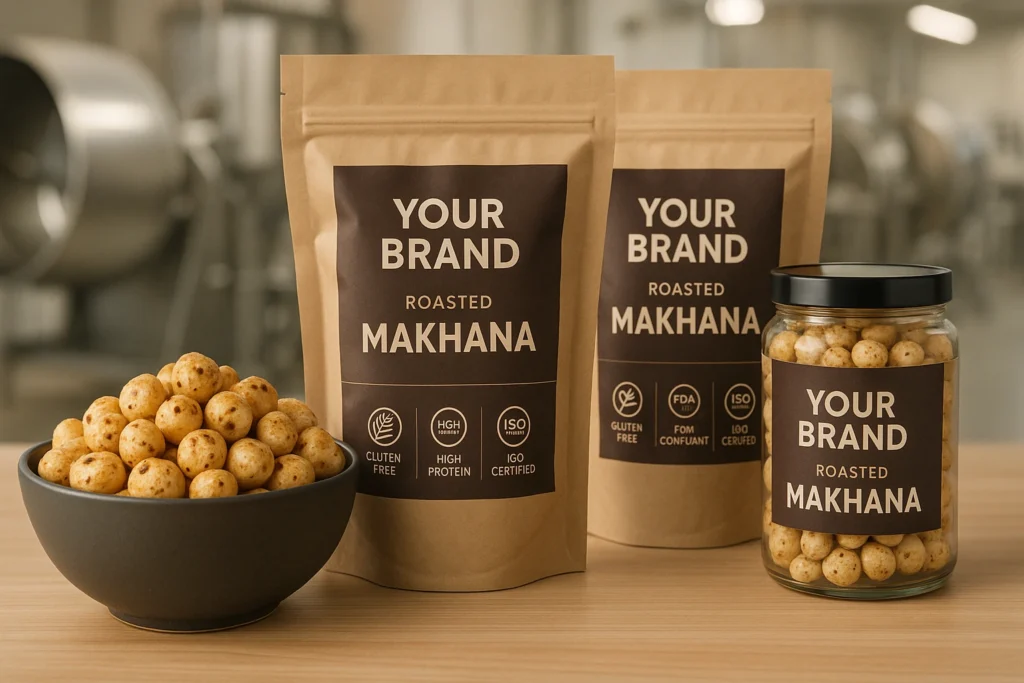
Makhana private labeling is not simply about outsourcing production; it is a structured business process that transforms a snack idea into a scalable commercial product. Brands that succeed with private labeling follow a clear execution path—moving from concept validation to consistent market supply without operational chaos.
Understanding this journey helps brands reduce mistakes, shorten timelines, and scale with confidence.
Stage 1: Concept Definition and Market Fit
Every makhana private labeling project begins with defining the product’s role in the market. This stage answers critical questions:
-
Who is the target consumer?
-
Is the product positioned as healthy, premium, functional, or mass-market?
-
Will it compete on taste, nutrition, or convenience?
Clear answers prevent misalignment later in formulation and packaging decisions.
Stage 2: Product Architecture and Formulation Planning
Once the concept is clear, makhana private labeling moves into formulation architecture. This stage determines:
-
Roasting style (light, medium, crunchy)
-
Flavour direction (clean-label, seasoned, gourmet)
-
Nutritional positioning (low sodium, high protein, minimal oil)
Unlike trial-and-error manufacturing, private labeling relies on tested formulation frameworks that reduce development risk.
Stage 3: Process Design and Production Mapping
Commercial success requires predictable processes. During this stage, the private label manufacturer maps:
-
Raw makhana sourcing standards
-
Cleaning, grading, and roasting parameters
-
Seasoning application methods
-
Cooling, packing, and sealing workflows
This process design ensures that the same product can be produced repeatedly at scale without variation.
Stage 4: Packaging Engineering and Shelf Stability
Packaging is not a branding-only decision in makhana private labeling. It directly affects freshness, shelf life, and logistics. At this stage, brands finalize:
-
Pack size strategy
-
Material selection (pouches, jars, eco-friendly formats)
-
Oxygen and moisture protection requirements
Proper packaging engineering prevents spoilage and retail rejections.
Stage 5: Compliance, Labeling, and Documentation
As products move closer to commercialization, compliance becomes critical. Makhana private labeling includes:
-
Nutritional value calculation
-
Ingredient and allergen declarations
-
Batch traceability systems
-
Export or retail-ready documentation
This stage ensures smooth onboarding with distributors, retailers, and eCommerce platforms.
Stage 6: Pilot Runs and Market Testing
Before full-scale launch, controlled pilot batches are produced. These runs help brands:
-
Validate taste consistency
-
Test packaging durability
-
Collect early customer feedback
-
Adjust formulations if required
Pilot runs reduce large-scale failure risks and support data-backed decisions.
Stage 7: Commercial Scale Production
Once validated, makhana private labeling transitions into commercial scale. This stage focuses on:
-
Volume planning
-
Lead-time management
-
Inventory synchronization with sales channels
-
Maintaining batch-to-batch consistency
Scalable systems allow brands to grow without operational breakdowns.
Stage 8: Ongoing Optimization and SKU Expansion
Private labeling does not stop at launch. Brands continuously optimize:
-
Cost structures
-
Flavour variants
-
Pack-size diversification
-
Market-specific adaptations
This flexibility allows rapid portfolio expansion without restarting the entire process.
How Annakosha Pvt. Ltd. Helps
Annakosha Pvt. Ltd. supports makhana private labeling by managing the entire journey—from concept structuring and formulation to scalable production, packaging engineering, and compliance readiness. Their system-driven approach enables brands to move confidently from idea stage to commercial-scale supply without operational friction.
FAQs
1. What is makhana private labeling?
Makhana private labeling is a model where a manufacturer produces fox nut snacks under a brand’s name using standardized, scalable systems.
2. How long does it take to launch a product through private labeling?
Timelines vary, but private labeling significantly reduces launch time compared to setting up in-house manufacturing.
3. Can products be scaled after launch?
Yes, private labeling is designed to support gradual and large-scale volume expansion without quality loss.
4. Is customization possible at each stage?
Absolutely, brands can customize formulation, packaging, and positioning while relying on standardized production systems.
5. Is private labeling suitable for new brands?
Yes, it allows start-ups to enter the market professionally without heavy capital investment.
