
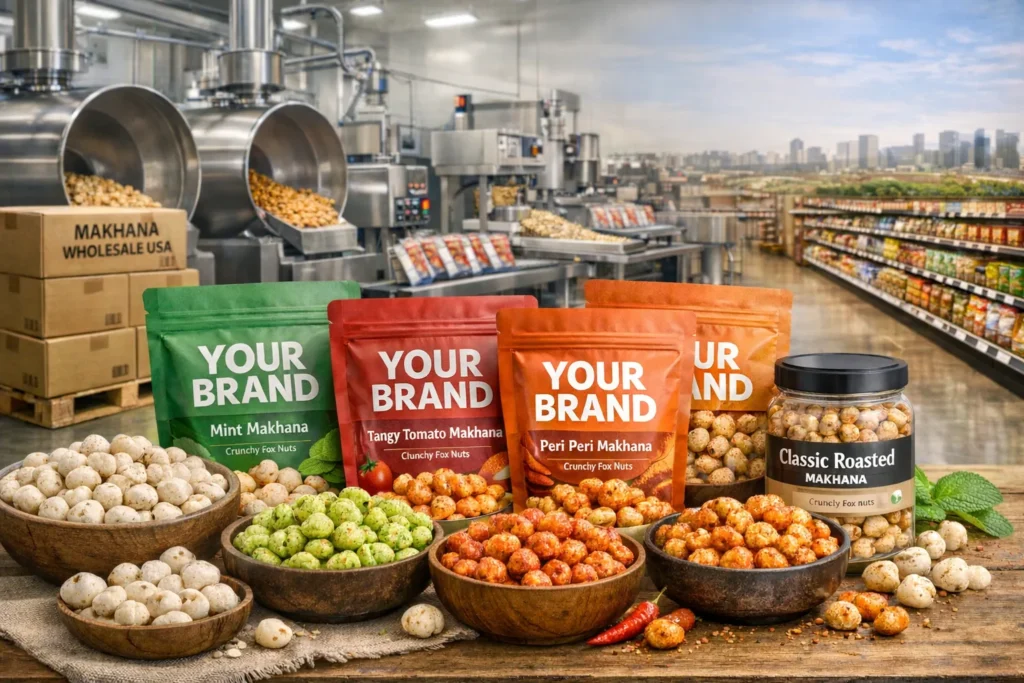
Private label makhana manufacturer partnerships are no longer just about outsourcing production—they function as a risk-control framework for new and growing snack brands. In a market where failed launches often result from supply inconsistency, regulatory gaps, and cost overruns, private labelling shifts uncertainty away from the brand and into proven manufacturing systems.
Launching a snack brand with makhana involves more than sourcing fox nuts. It requires predictable quality, food safety compliance, packaging precision, and the ability to scale quickly. A private label makhana manufacturer integrates all these variables into a single, controlled process.
Why Snack Brand Launches Fail Without the Right Manufacturing Model
Most snack brands fail early due to operational risks rather than marketing mistakes. These risks typically include:
-
Inconsistent raw material quality
-
Unstable roasting and seasoning outcomes
-
Labelling errors causing regulatory delays
-
Inability to meet repeat orders
-
Rising costs from inefficient production
A private label makhana manufacturer minimizes these risks by operating within predefined systems, tested processes, and compliance-driven workflows.
How Private Label Manufacturing Reduces Operational Uncertainty
1. Standardized Quality From Day One
A private label makhana manufacturer works with fixed specifications for size, texture, moisture, and roasting profiles. This ensures that every batch delivered to market matches the previous one—an essential factor for brand trust and retailer acceptance.
2. Predictable Cost Structure
Unexpected cost escalations are a major threat during brand launches. With private labelling, brands operate on contract-based pricing models, eliminating surprises related to labour, machinery, wastage, or process inefficiencies.
This predictability allows brands to price confidently and protect margins.
3. Built-In Food Safety & Compliance
Compliance failures can halt a brand overnight. A private label makhana manufacturer operating under FDA-aligned and export-ready standards ensures:
-
Batch traceability
-
Accurate nutritional labelling
-
Hygiene-controlled processing
This dramatically lowers regulatory and legal exposure.
4. Faster Time-to-Market
Speed reduces risk. The longer a brand takes to launch, the higher the capital burn and competitive pressure. A private label makhana manufacturer already has infrastructure, trained teams, and certifications in place—allowing brands to move from concept to shelf-ready products quickly.
Risk Reduction Through Scalability
Scaling too early or too late can damage a brand. Private label manufacturing offers elastic scalability, meaning production volumes increase only when demand justifies it.
This avoids:
-
Overstocking risks
-
Under-supplying retail partners
-
Emergency production costs
A private label makhana manufacturer adjusts output without requiring the brand to invest in new assets or staff.
Brand Control Without Manufacturing Exposure
Contrary to common myths, working with a private label makhana manufacturer does not reduce brand ownership. Brands retain full control over:
-
Brand identity
-
Product positioning
-
Flavour profiles
-
Packaging design
-
Market strategy
The manufacturer manages execution, not branding decisions—keeping strategic control firmly with the brand owner.
Retail & Distributor Confidence
Retail buyers prefer brands backed by professional manufacturing partners. Products produced by a private label makhana manufacturer are more likely to meet:
-
Shelf-life expectations
-
Packaging standards
-
Barcoding and logistics requirements
This increases acceptance rates during distributor and retail onboarding.
How Annakosha Pvt. Ltd. Helps
Annakosha Pvt. Ltd. supports brands as a private label makhana manufacturer by offering compliant processing, customized formulations, scalable production, and export-ready documentation. Their integrated approach reduces launch risk while enabling consistent quality, faster market entry, and long-term brand scalability.
FAQs
1. What does a private label makhana manufacturer do?
A private label makhana manufacturer produces, flavours, packages, and ensures compliance for makhana products sold under another brand’s name.
2. How does private labelling reduce brand launch risk?
It eliminates manufacturing investment, ensures regulatory readiness, stabilizes costs, and provides consistent quality from the first batch.
3. Is private label manufacturing suitable for start-ups?
Yes, it allows start-ups to launch professionally without capital-heavy infrastructure or technical expertise.
4. Can brands scale quickly with private label makhana?
Absolutely, production volumes can be increased without operational disruptions or new investments.
5. Does private labelling affect brand uniqueness?
No, brands fully control flavours, packaging, positioning, and market strategy while outsourcing production execution.
