
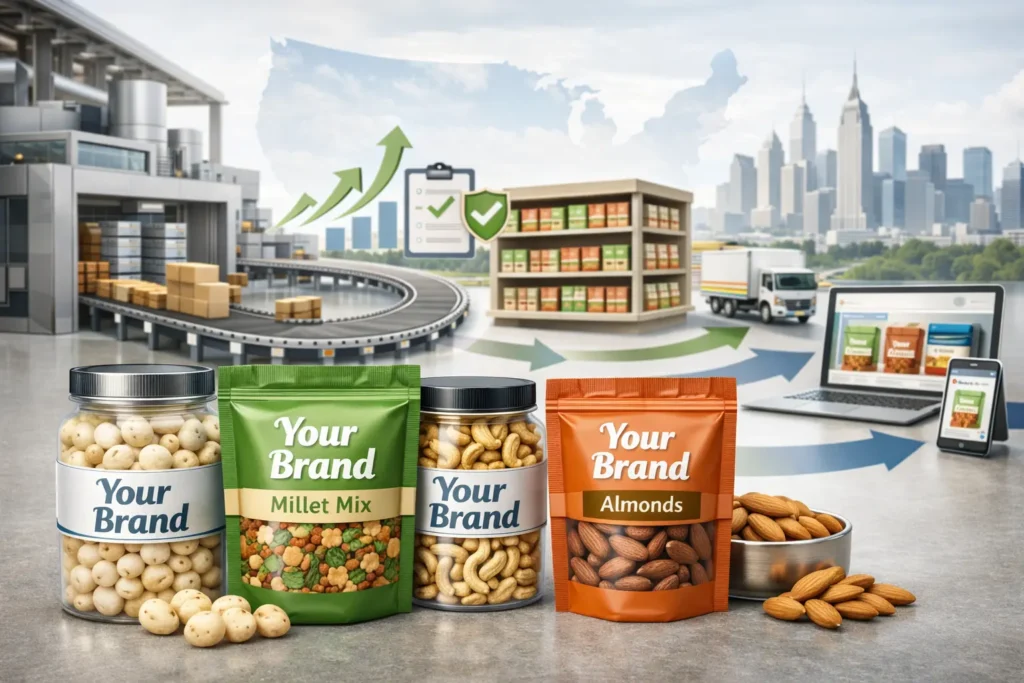
Snack Business USA brands scale faster with private labeling because it eliminates operational bottlenecks while delivering speed, consistency, and control. In a market as competitive and regulation-driven as the United States, growth depends not only on demand but on flawless execution.
Snack brands that attempt to scale through in-house manufacturing often face delays, compliance hurdles, and rising costs. Private labeling flips this model by making growth modular, predictable, and efficient.
Below are 11 strategic reasons why private labeling has become the preferred growth engine for scaling a snack business in the USA.
1. No Manufacturing Infrastructure Required
Scaling a snack business USA traditionally demands factories, machinery, and trained teams. Private labeling eliminates this burden entirely. Brands can increase production without purchasing equipment or expanding facilities.
This asset-light approach allows capital to be invested where it matters most—marketing, distribution, and brand visibility.
2. Faster Production Turnaround
Speed is critical when demand spikes or trends shift. Private label manufacturers already operate at scale, enabling faster production cycles compared to in-house setups.
This allows brands to:
-
Replenish inventory quickly
-
Respond to seasonal demand
-
Launch new SKUs faster
3. Built-In Regulatory Compliance
Scaling often exposes brands to compliance risks. Private label partners operate within established food safety and labeling frameworks, reducing regulatory friction as volumes increase.
For a snack business USA, this means growth without legal setbacks.
4. Predictable Cost Structure
Private labeling converts fixed manufacturing costs into predictable per-unit pricing. As volume grows, brands gain better cost visibility and improved margin planning.
This predictability supports confident scaling decisions.
5. Consistent Product Quality at Higher Volumes
Maintaining taste, texture, and shelf life becomes more challenging as production increases. Private label systems rely on standardized processes that protect consistency across batches.
Consistency builds consumer trust—essential for scaling.
6. Easier Expansion Across Sales Channels
A growing snack business USA rarely sells through one channel alone. Private labeling supports smooth expansion into:
-
eCommerce
-
Retail chains
-
Distributors
-
Foodservice
Products are designed to meet multi-channel requirements from the start.
7. Faster Market Testing
Private labeling enables brands to test new flavors, formats, or positioning with limited risk. Instead of committing to large infrastructure changes, brands can test small batches and scale only what works.
This data-driven scaling reduces failure rates.
8. Reduced Operational Complexity
As brands grow, operational decisions multiply. Private labeling simplifies backend operations, allowing leadership to focus on growth strategy rather than production management.
Less complexity equals faster decision-making.
9. Supply Chain Stability
Scaling requires reliable sourcing and production continuity. Private label manufacturers maintain established supplier networks and inventory systems that protect against disruptions.
This stability supports long-term scaling plans.
10. Brand Control Without Production Control
Scaling does not mean giving up brand ownership. Private labeling allows brands to fully control:
-
Branding
-
Pricing
-
Market positioning
-
Customer relationships
Manufacturing stays in the background while the brand scales front-facing growth.
11. Designed for Long-Term Growth, Not Just Launch
Private labeling is not a short-term solution. It is built for gradual, controlled scaling—whether that means regional expansion, national retail presence, or product line diversification.
For a snack business USA, this future-ready structure is a major advantage.
FAQs
1. Why is private labeling effective for scaling a snack business USA?
It removes infrastructure limits and allows brands to grow production without operational expansion.
2. Can small snack brands scale using private labeling?
Yes, private labeling allows brands to start small and scale gradually based on demand.
3. Does private labeling reduce brand control?
No, brands retain full ownership of branding, pricing, and distribution.
4. Is private labeling suitable for long-term growth?
Absolutely, it is designed to support multi-channel and multi-market expansion.
