
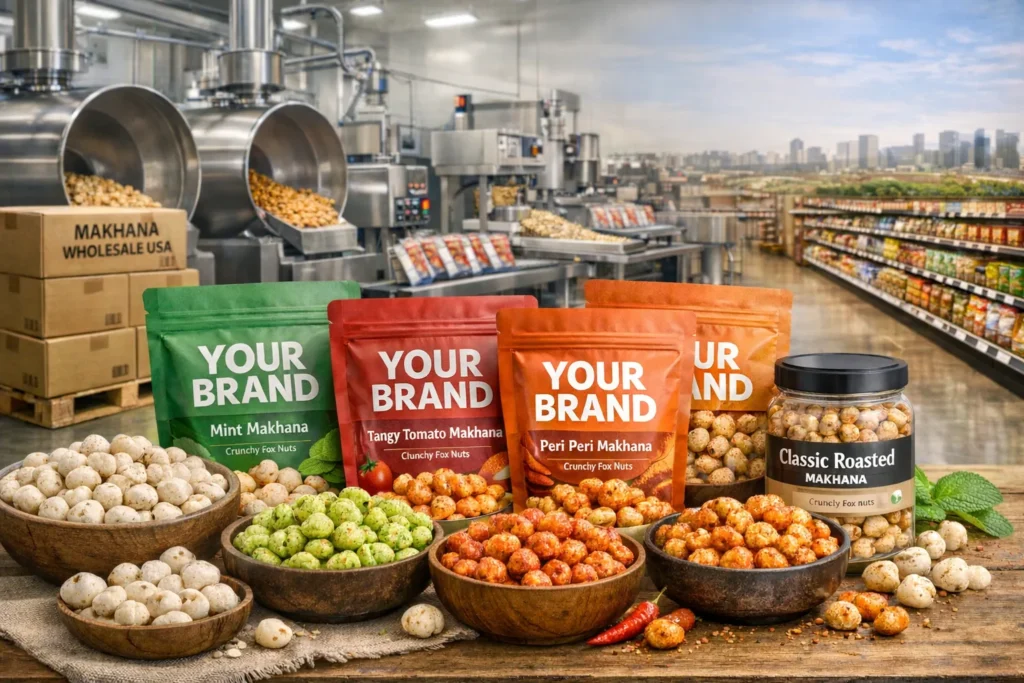
Private label makhana manufacturer partnerships play a critical role in transforming raw fox nuts into successful snack brands. Behind every retail-ready makhana product lies a structured process that connects manufacturing expertise with market expectations. From sourcing and processing to packaging and compliance, a private label makhana manufacturer acts as the bridge between production and consumer purchase.
As the demand for healthy, plant-based snacks continues to rise, brands can no longer rely on ad-hoc manufacturing. They need partners who understand both production efficiency and market readiness.
The Manufacturing Foundation: Where Quality Begins
The journey starts with raw material management. A professional private label makhana manufacturer focuses heavily on sourcing consistency. Fox nuts are graded based on size, texture, moisture content, and cleanliness to ensure uniform roasting and crunch.
This manufacturing discipline prevents common issues such as uneven expansion, burnt kernels, or inconsistent mouthfeel—problems that often damage brand credibility.
Advanced roasting systems and standardized seasoning techniques allow manufacturers to deliver predictable taste and texture across batches, a requirement for brands selling at scale.
Product Development Aligned With Market Needs
Manufacturing alone does not create a successful snack brand. A private label makhana manufacturer supports product development that aligns with evolving consumer preferences.
This includes:
-
Flavor profiles tailored to health-focused or gourmet segments
-
Clean-label and low-oil formulations
-
Balanced seasoning intensity for mass or premium markets
Instead of trial-and-error, brands benefit from tested formulations that reduce risk and shorten development timelines.
Packaging That Translates Production into Sales
Packaging is where manufacturing meets marketing. A private label makhana manufacturer ensures that products are packed in formats that protect freshness while enhancing shelf appeal.
Common packaging support includes:
-
Resealable pouches for convenience-driven consumers
-
Jars or tubs for premium positioning
-
Export-friendly packaging with strong barrier properties
Proper packaging extends shelf life, reduces returns, and improves customer satisfaction—key factors for repeat purchases.
Compliance and Quality Control for Market Acceptance
Retailers, distributors, and eCommerce platforms demand compliance. A professional private label makhana manufacturer integrates quality control into every stage of production.
This includes:
-
Hygienic processing environments
-
Batch-level traceability
-
Shelf-life validation
-
Accurate nutritional and ingredient labeling
Compliance not only protects consumers but also speeds up approvals with organized retail and international buyers.
From Factory Output to Retail Readiness
One of the most valuable roles of a private label makhana manufacturer is converting production output into retail-ready products. This involves barcoding, batch coding, standardized pack sizes, and logistics-friendly formats.
These backend details determine whether a product can scale smoothly across:
-
Online marketplaces
-
Modern retail chains
-
Export distributors
Without this structure, even high-quality products struggle to reach wider markets.
Enabling Scalable Growth Without Operational Burden
Scaling a snack brand internally often leads to operational bottlenecks. Private labeling removes these constraints by offering flexible production capacity.
Brands can:
-
Launch with limited quantities
-
Increase volumes based on demand
-
Add new SKUs without new infrastructure
-
Maintain consistent quality during expansion
This flexibility allows brands to grow confidently without capital-intensive investments.
Who Benefits Most From This Model
The private label makhana manufacturing model is especially valuable for:
-
Startup snack brands
-
D2C and eCommerce-first businesses
-
Retailers developing in-house brands
-
Export-oriented food companies
It allows these businesses to compete with established brands while staying lean and agile.
FAQs
1. What is the role of a private label makhana manufacturer?
They manage production, roasting, seasoning, packaging, and quality control for makhana snacks sold under your brand name.
2. Does private labeling help brands reach the market faster?
Yes, it eliminates factory setup and speeds up production timelines significantly.
3. Can private label manufacturers support multiple sales channels?
Yes, products are designed for retail, eCommerce, and export markets.
4. Is private labeling suitable for long-term growth?
Absolutely, it provides scalability, consistency, and cost control.
