
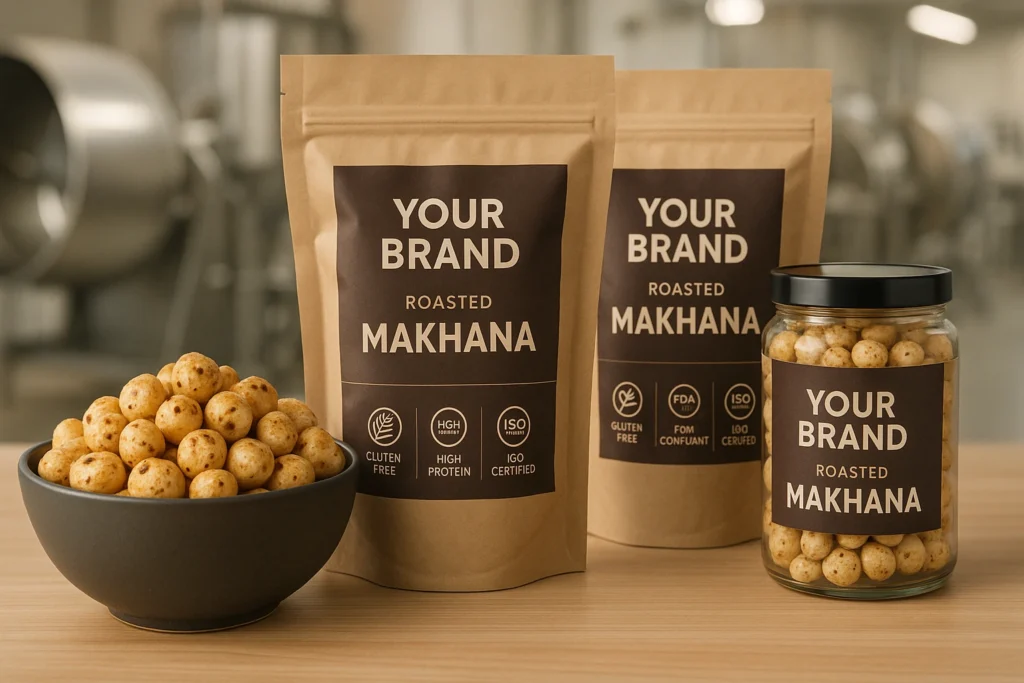
Private label makhana manufacturer selection is one of the most critical decisions a snack brand will make when planning long-term, sustainable growth. While makhana (fox nuts) continues to gain popularity as a clean-label, plant-based snack across global markets, not every manufacturing partner is equipped to support consistent quality, scalability, and regulatory readiness over time.
Choosing the right manufacturer is not just about production—it is about building a foundation that supports brand reputation, market expansion, and operational stability for years to come.
Why Manufacturer Choice Defines Brand Longevity
Many snack brands focus on speed to market but overlook long-term execution. A reliable private label makhana manufacturer ensures that as demand grows, quality remains consistent and supply chains remain stable.
An unsuitable partner can lead to:
-
Inconsistent taste or texture
-
Supply interruptions
-
Compliance risks in export markets
-
Difficulty scaling production
A strong manufacturing partner, on the other hand, becomes an extension of your brand’s growth strategy.
Core Capabilities to Look for in a Private Label Partner
Long-term growth requires more than basic processing. When evaluating a private label makhana manufacturer, brands should assess operational depth rather than short-term convenience.
Key capabilities include:
-
Reliable sourcing of graded, premium makhana
-
Controlled roasting and seasoning systems
-
Consistent batch-level quality checks
-
Flexible packaging options
-
Capacity to scale volumes without compromising standards
These factors directly affect product consistency, retailer acceptance, and consumer trust.
Scalability Without Operational Disruption
One of the biggest advantages of private labeling is the ability to scale without building factories. However, not all manufacturers are prepared for volume expansion.
A growth-ready private label makhana manufacturer should:
-
Support low initial order quantities
-
Offer predictable lead times
-
Handle increasing volumes smoothly
-
Maintain consistent specifications across batches
This ensures brands can move from online sales to regional distribution and eventually to national or international retail without changing partners.
Customization That Evolves With the Market
Consumer preferences change rapidly. Long-term success depends on adaptability. The right manufacturing partner allows brands to refine products over time instead of locking them into rigid formulations.
Customization options should include:
-
Flavor and seasoning flexibility
-
Low-sodium or clean-label variations
-
Multiple pack sizes for different channels
-
Premium or eco-conscious packaging formats
This adaptability allows brands to stay relevant while keeping manufacturing centralized and efficient.
Compliance as a Growth Enabler, Not a Barrier
As brands expand into regulated markets like the USA, compliance becomes essential. A professional private label makhana manufacturer operates within established food safety systems that support long-term expansion.
Compliance-ready manufacturing helps with:
-
Retail onboarding requirements
-
Export documentation
-
Shelf-life validation
-
Nutritional labeling accuracy
Manufacturers aligned with FDA and international standards reduce risk and prevent costly setbacks as brands scale.
Supply Chain Stability and Transparency
Long-term growth depends on dependable sourcing. Seasonal fluctuations, inconsistent grading, or unreliable suppliers can disrupt production and brand reputation.
An experienced private label makhana manufacturer maintains:
-
Strong procurement networks
-
Raw material traceability
-
Buffer stock planning
-
Quality audits across sourcing stages
This stability protects brands from supply shocks and ensures continuity even during demand spikes.
Cost Predictability and Margin Control
Growth planning requires financial clarity. Private labeling converts manufacturing into predictable, volume-based costs rather than variable operational expenses.
This model supports:
-
Better margin planning
-
Controlled cost escalation
-
Flexible pricing strategies
-
Efficient cash flow management
Over time, predictable costs become a strategic advantage rather than a limitation.
Building a Partnership, Not Just a Product
The most successful snack brands view manufacturing as a partnership rather than a transaction. A reliable private label makhana manufacturer supports innovation, continuous improvement, and shared growth goals.
Such partnerships enable brands to:
-
Launch new SKUs faster
-
Enter new markets with confidence
-
Maintain consistent quality at scale
-
Build long-term brand equity
FAQs
1. What does a private label makhana manufacturer do?
They handle sourcing, processing, seasoning, packaging, and quality control while allowing brands to sell makhana products under their own name.
2. Why is manufacturer selection important for long-term growth?
Because consistency, scalability, compliance, and supply stability directly impact brand reputation and expansion capability.
3. Can private label makhana manufacturing support global markets?
Yes, with export-ready processes and regulatory alignment, it supports international distribution.
4. Is private labeling suitable for growing snack brands?
Absolutely, it allows brands to scale without infrastructure investment while maintaining professional-grade quality.
