
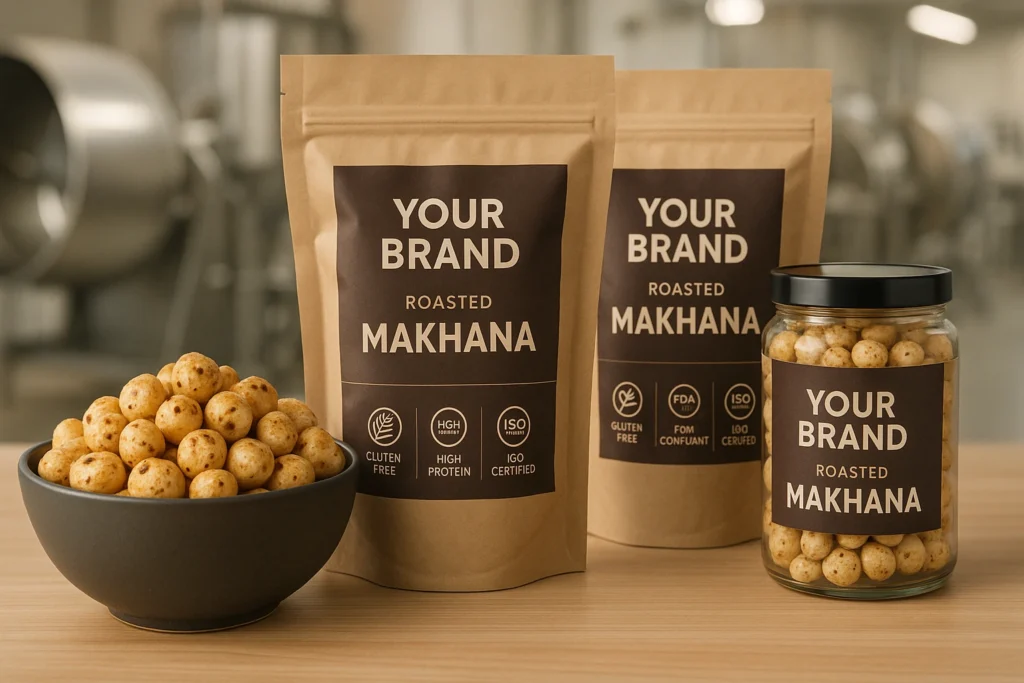
Makhana private labeling has emerged as a powerful growth strategy for snack brands that want to scale quickly without investing in manufacturing infrastructure. As global consumers increasingly seek healthy, plant-based, and clean-label snacks, fox nuts have gained recognition across wellness, gourmet, and functional food segments. However, building a factory, managing production teams, and handling compliance can slow growth and increase risk.
Private labeling offers an alternative path—one that allows brands to enter and expand in the makhana market while remaining agile, cost-efficient, and focused on brand-building rather than operations.
1. Zero Capital Investment in Manufacturing
One of the biggest advantages of makhana private labeling is the ability to launch products without owning a production facility. Manufacturing equipment, roasting systems, seasoning technology, and packaging lines require significant capital investment.
With private labeling, brands bypass these costs entirely. This makes it easier to allocate resources toward marketing, distribution, and customer acquisition instead of fixed assets.
2. Faster Go-To-Market Timelines
Speed matters in the snack industry. Consumer preferences evolve quickly, and brands that respond faster often gain a competitive edge. Private labeling significantly shortens the time between concept and launch.
Established manufacturers already have production-ready systems in place, allowing brands to:
-
Introduce products faster
-
Respond to trends quickly
-
Test new ideas without long setup delays
This speed is difficult to achieve with in-house manufacturing.
3. Professional Quality Without Operational Complexity
Makhana production requires precision. Factors such as roasting consistency, moisture control, seasoning adhesion, and shelf-life stability directly affect product quality.
Private label partners bring standardized processes and experienced teams that ensure consistent results. Brands benefit from professional-grade production without managing daily operational challenges.
4. Scalable Production as Demand Grows
Scaling manufacturing internally often means purchasing new equipment, hiring staff, and expanding facilities. With private labeling, scalability is built into the model.
Brands can:
-
Start with smaller volumes
-
Increase production gradually
-
Expand into new regions smoothly
This flexibility allows businesses to grow in line with demand, reducing the risk of overproduction or excess inventory.
5. Customization Without Technical Risk
Differentiation is essential in a crowded snack market. Makhana private labeling allows brands to customize products while avoiding technical trial-and-error.
Customization may include:
-
Flavor profiles and seasoning intensity
-
Clean-label or low-sodium positioning
-
Texture and roasting preferences
-
Pack sizes and formats
The manufacturing partner manages formulation and production testing, minimizing risk for the brand.
6. Consistent Quality Across Markets
Brand trust depends on consistency. Whether a customer buys the product online or in a retail store, the taste and quality must remain the same.
Private label manufacturers rely on standardized operating procedures and batch-level quality checks. This ensures uniformity across production runs, which is especially important for brands selling in multiple regions or countries.
7. Regulatory and Compliance Support
Selling food products internationally requires compliance with various food safety, labeling, and packaging regulations. Navigating these requirements independently can be complex and time-consuming.
Private label partners with export experience help manage:
-
Hygienic processing standards
-
Shelf-life and stability testing
-
Nutritional labeling accuracy
-
Documentation for cross-border trade
This compliance readiness enables brands to expand globally with confidence.
8. Cost Control and Predictable Margins
Private labeling converts manufacturing costs into predictable, volume-based expenses. Brands avoid the uncertainties associated with equipment maintenance, labor management, and facility overheads.
This model helps:
-
Improve cash flow
-
Maintain predictable per-unit costs
-
Adjust production based on sales performance
Better cost control supports long-term profitability and planning.
9. Strong Focus on Brand Building and Growth
By removing manufacturing from their responsibility, brands can focus on what truly drives growth—branding, storytelling, customer engagement, and channel expansion.
Private labeling allows businesses to operate lean while presenting themselves as premium, professional snack brands in the market.
Why Makhana Private Labeling Fits the Global Snack Market
Globally, consumers are moving toward plant-based, minimally processed snacks. Makhana fits this demand perfectly, but success depends on execution. Private labeling enables brands to deliver consistent quality, adapt quickly to trends, and scale across borders without operational strain.
This model is especially valuable for:
-
Startups and emerging brands
-
D2C and eCommerce-focused businesses
-
Retailers launching in-house brands
-
Export-oriented snack companies
FAQs
1. What is makhana private labeling?
Makhana private labeling is a business model where a manufacturer produces customized fox nut products exclusively for your brand.
2. Do I need a factory to start a makhana brand?
No, Private labeling allows you to launch and scale without owning manufacturing infrastructure.
3. Can private labeled makhana be sold internationally?
Yes, as long as products meet the required food safety and labeling standards of the target market.
4. Is private labeling suitable for small businesses?
Yes, It allows businesses to start small, test the market, and scale gradually with lower risk.
